
ERCOT's Nodal Operating Guide Revision Request 245 (NOGRR245) introduced significant changes to voltage and frequency ride-through requirements for inverter-based resources (IBRs) connected to the ERCOT transmission system.
Approved in September 2024 and effective October 1, 2024, NOGRR245 establishes performance requirements intended to reduce unnecessary generation disconnections during grid disturbances and improve system reliability.
For wind, solar photovoltaic (PV), and battery energy storage system (BESS) operators, compliance requires more than reviewing protection relay settings. It involves evaluating inverter capabilities, plant-level controls, dynamic models, equipment limitations, and the ability to maintain current injection during disturbances.
What Is ERCOT NOGRR245?
NOGRR245 establishes updated voltage and frequency ride-through requirements for transmission-connected IBRs and Type 1 and Type 2 wind-powered generation resources.
Its principal objectives include:
- Improving voltage and frequency disturbance ride-through performance.
- Establishing distinct Preferred and Legacy voltage ride-through requirements.
- Requiring facilities to maximize ride-through capability within equipment limitations.
- Improving coordination among inverter controls, plant controllers, and protection systems.
- Supporting alignment with relevant IEEE 2800-2022 performance requirements.
New Facilities vs. Legacy Facilities
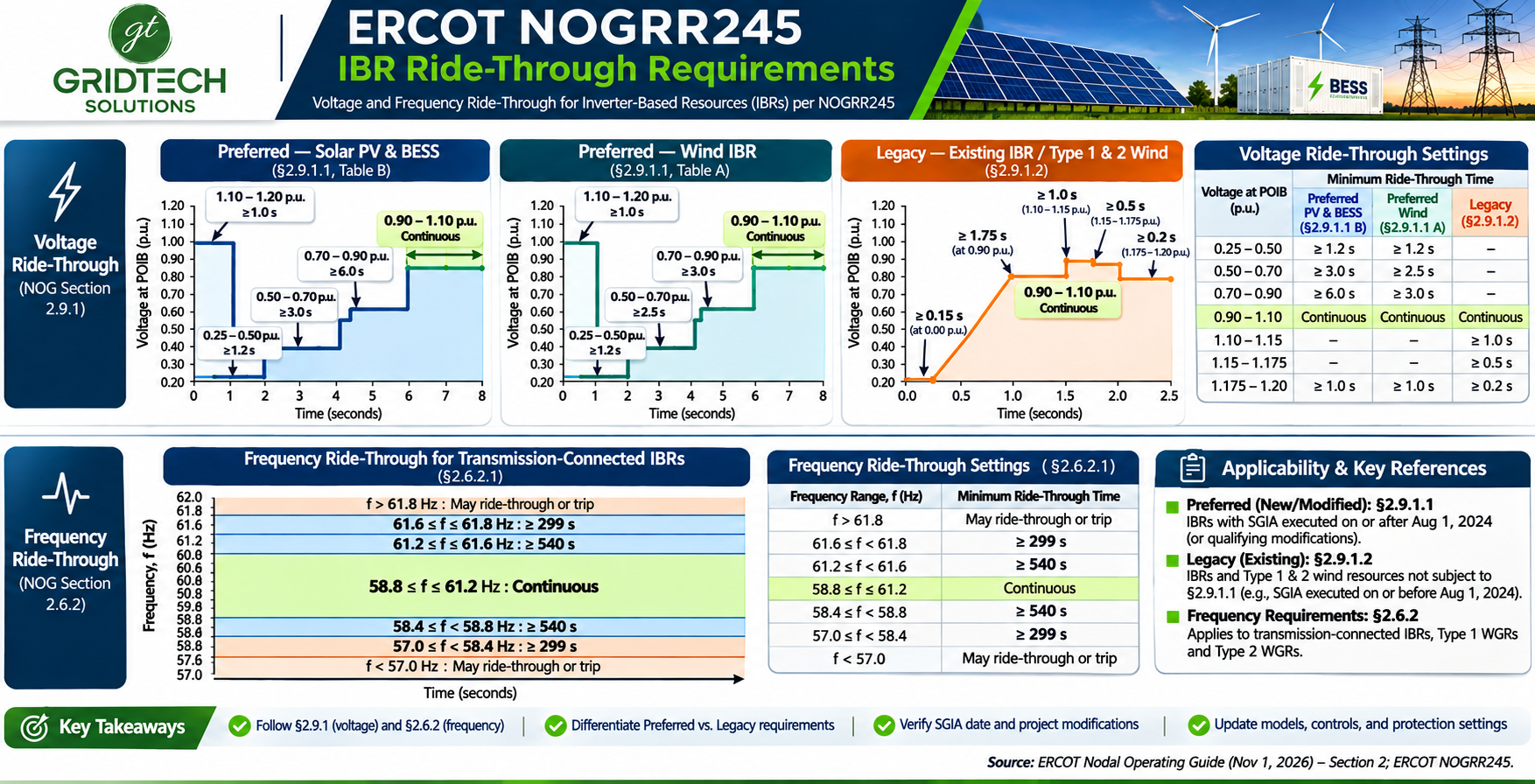
One of the most important aspects of NOGRR245 is the distinction between Preferred and Legacy voltage ride-through requirements.
Preferred requirements generally apply to IBRs with a Standard Generation Interconnection Agreement (SGIA) executed on or after August 1, 2024, as well as certain qualifying modified facilities.
Legacy requirements generally apply to IBRs not subject to the Preferred requirements and to Type 1 and Type 2 wind-powered generation resources.
Qualifying modifications and specific exceptions must be evaluated under ERCOT Nodal Operating Guide Section 2.9.1.
Importantly, legacy status does not eliminate ride-through obligations. Existing facilities are expected to maximize their performance within equipment limitations, subject to applicable requirements and approved relief.
Voltage Ride-Through Requirements
Preferred Requirements for Solar PV and BESS
For transmission-connected PV and energy storage IBRs subject to the Preferred requirements, ERCOT establishes minimum voltage ride-through durations measured at the Point of Interconnection Bus (POIB).
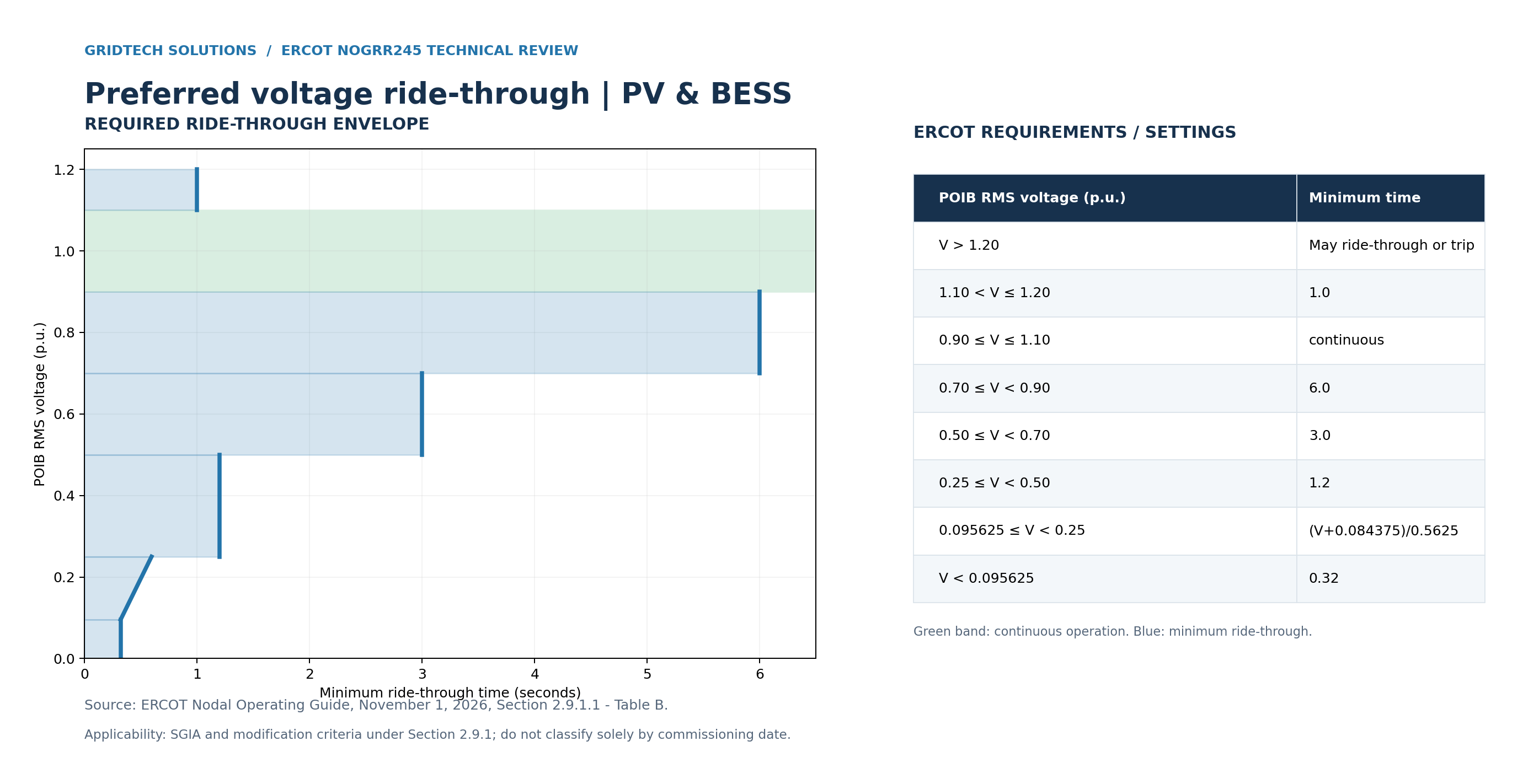
Additional low-voltage thresholds and time-duration relationships apply below 0.25 p.u.
Preferred Requirements for Wind IBRs
For wind IBRs subject to the Preferred requirements, the corresponding durations differ:
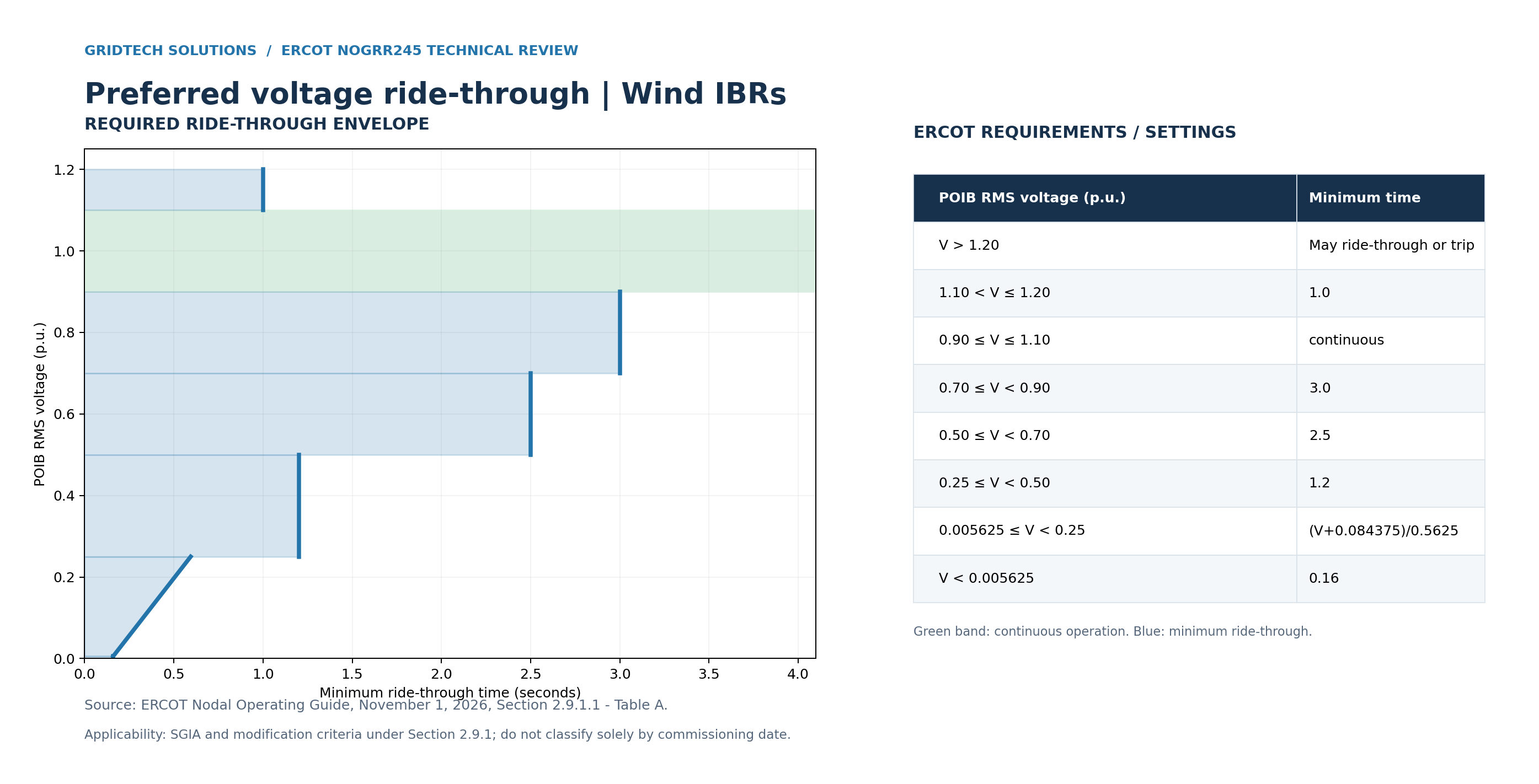
Legacy Voltage Ride-Through Requirements
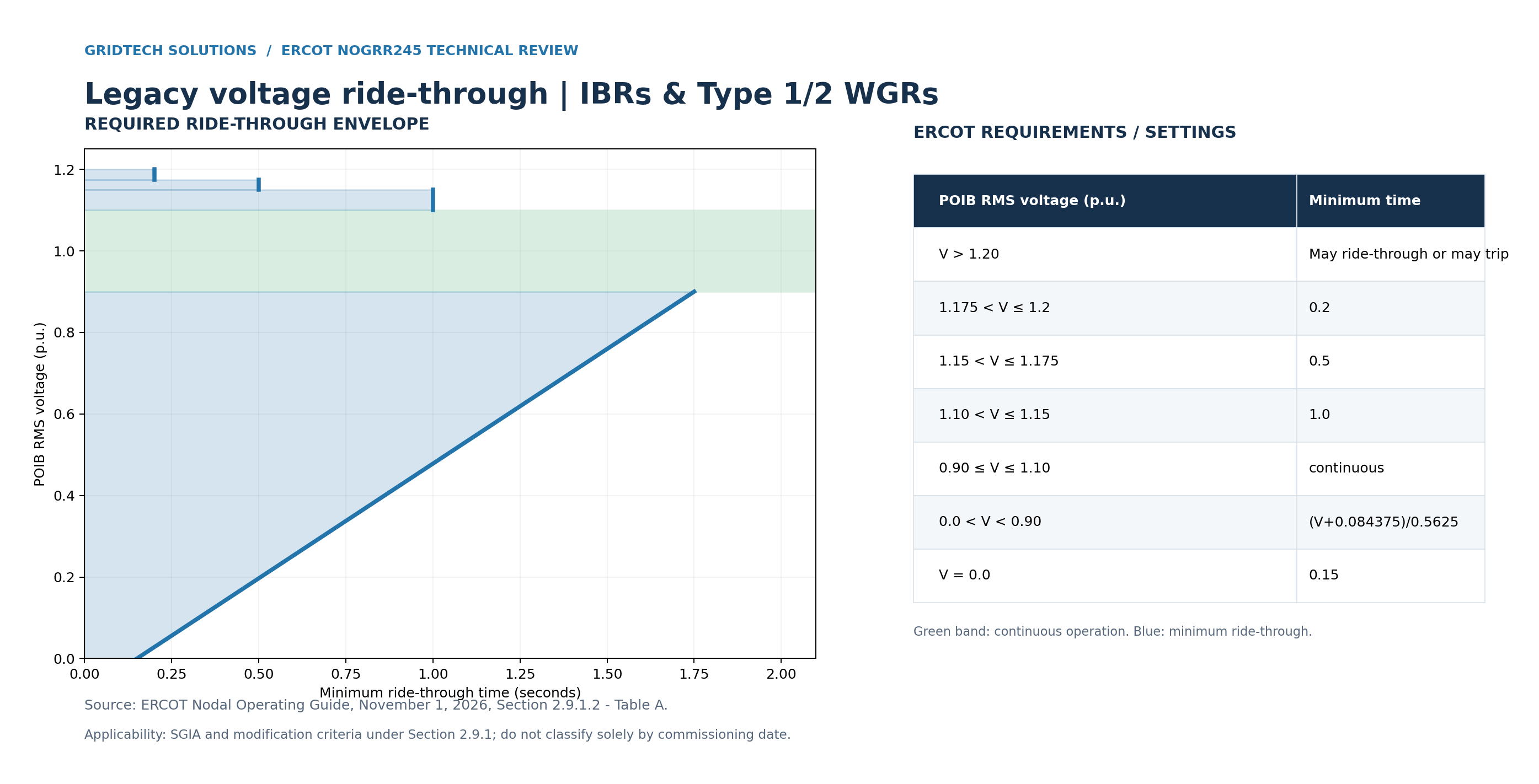
Legacy facilities follow a separate voltage ride-through profile.
The continuous operating voltage range is 0.90–1.10 p.u. For lower voltages, the required ride-through duration follows a defined linear relationship, extending from 0.15 seconds at zero voltage to 1.75 seconds at 0.90 p.u.
For high-voltage disturbances, minimum durations include:
- Above 1.10 through 1.15 p.u.: 1.0 second.
- Above 1.15 through 1.175 p.u.: 0.5 seconds.
- Above 1.175 through 1.20 p.u.: 0.2 seconds.
These distinctions are important when assessing existing wind farms and older inverter installations.
Frequency Ride-Through Requirements
NOGRR245 also establishes frequency ride-through requirements for transmission-connected IBRs and applicable wind resources.
The required frequency performance includes:
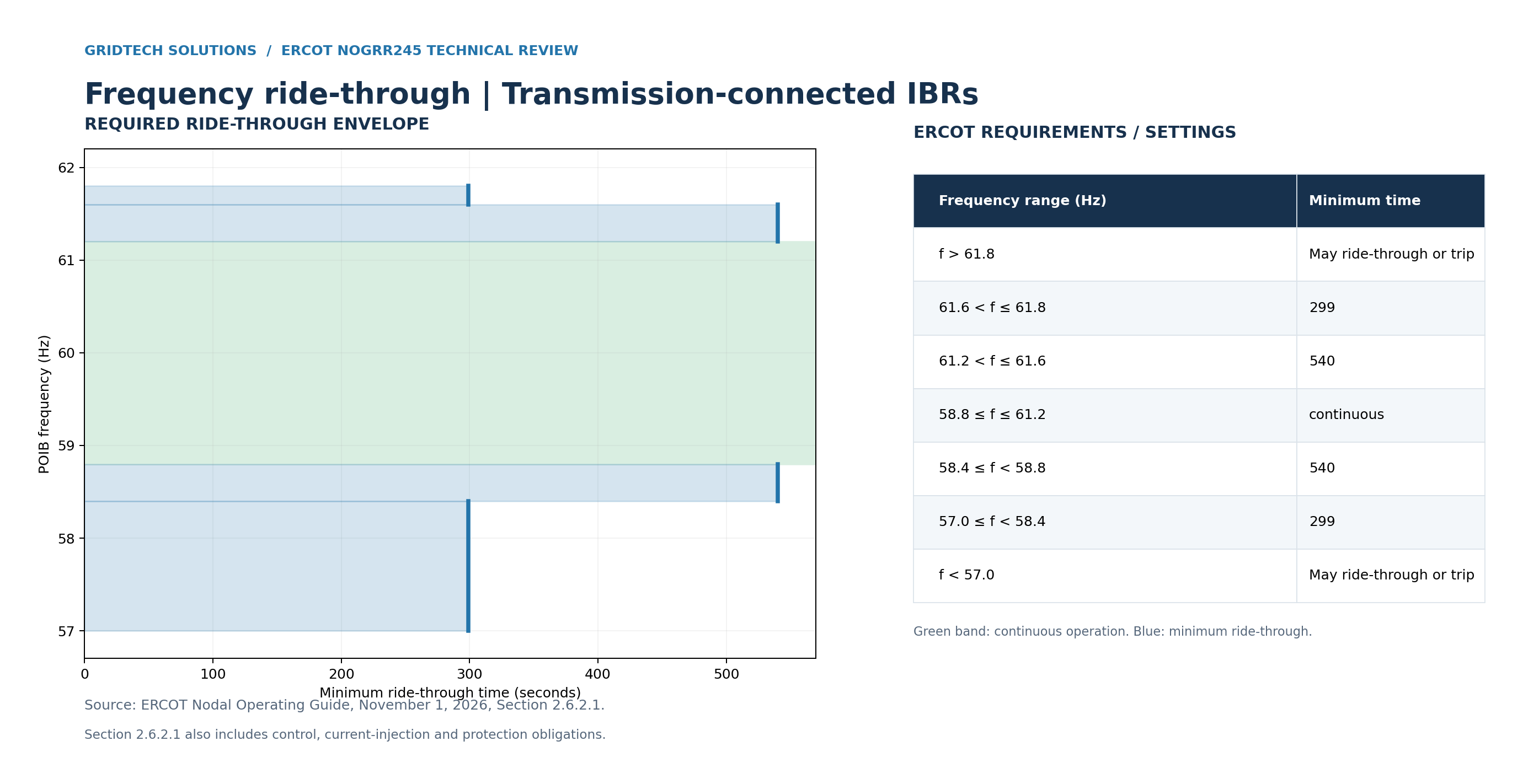
Additional temporary provisions may apply to qualifying legacy facilities.
Frequency ride-through assessments must consider over-frequency and under-frequency protection, plant controller behavior, inverter operating limitations, and continuity of current injection.
What Should Be Tested for NOGRR245 Compliance?
A comprehensive engineering assessment should address the following areas.
1. Low-voltage ride-through (LVRT)
Evaluate the facility response to voltage depressions at the POIB, including inverter current injection, protective actions, plant controller response, and post-fault recovery.
2. High-voltage ride-through (HVRT)
Assess the ability to remain connected during temporary overvoltage conditions without unnecessary inverter or plant-level disconnection.
3. Frequency ride-through
Evaluate under-frequency and over-frequency conditions against the applicable frequency-duration requirements, including coordination with frequency protection settings.
4. Current injection and recovery
Verify that the facility maintains required current exchange during disturbances and restores active power appropriately following voltage recovery.
5. Protection and control coordination
Review inverter protection, collector-system relays, substation protection, plant controller settings, and relevant OEM control limitations.
6. Dynamic model accuracy
Confirm that the PSS®E or other applicable dynamic model accurately represents the installed inverter firmware, plant controller configuration, protection behavior, and equipment capabilities.
GridTech Solutions' Engineering Approach
GridTech Solutions supports renewable generation owners, developers, and operators with technical evaluations addressing ERCOT ride-through requirements.
Our engineering methodology includes:
Model review and development: Review existing PSS®E models, inverter parameters, plant controller settings, and as-built system configuration.
Ride-through simulations: Perform applicable voltage and frequency disturbance simulations to evaluate plant-level performance.
Protection assessment: Compare inverter and relay settings against the applicable ride-through requirements and equipment protection limitations.
OEM coordination: Identify available firmware, software, or settings changes that may improve performance.
Compliance gap assessment: Document deficiencies, limitations, potential corrective measures, and additional engineering evaluations.
Technical documentation: Prepare simulation results, engineering recommendations, and supporting technical documentation for resource owners and regulatory submissions.
Where RMS models cannot accurately represent a particular control or protection response, additional OEM information or EMT modeling may be necessary.
Considerations for Existing Wind and Solar Facilities
Legacy facilities may face additional challenges because their installed inverter or turbine technology was developed before the latest ride-through requirements.
Common engineering considerations include:
- Limited firmware or control upgrade options.
- Protection settings that may conflict with ride-through objectives.
- Differences between the submitted dynamic model and actual equipment behavior.
- Insufficient current injection during voltage disturbances.
- Delayed active power recovery.
- Equipment limitations requiring documented technical justification.
For these facilities, an effective compliance strategy begins with an accurate understanding of existing equipment capabilities.
Supporting Grid Reliability Through Better Models and Controls
NOGRR245 reinforces the importance of coordinating grid performance requirements with inverter capabilities, protection systems, and validated dynamic models.
For both new and legacy facilities, a structured technical assessment can identify performance limitations, improve ride-through behavior, and support informed compliance decisions.
GridTech Solutions provides power system modeling, transient stability studies, protection assessments, inverter-based resource compliance support, and engineering evaluations for renewable generation facilities across the United States.
For technical assistance with ERCOT NOGRR245, contact info@gridtechsolution.com.
Technical References
- ERCOT NOGRR245 — Inverter-Based Resource Ride-Through Requirements.
- ERCOT Nodal Operating Guide, Section 2.6.2.1 — Frequency Ride-Through.
- ERCOT Nodal Operating Guide, Section 2.9.1 — Voltage Ride-Through.
- IEEE Std 2800-2022 — Interconnection and Interoperability of Inverter-Based Resources.