

GridTech Solutions provides specialized engineering support for transmission-connected inverter-based resources, including IEEE 2800 performance assessments, RMS and EMT simulations, voltage and frequency ride-through evaluations, model verification, and technical documentation for utilities, developers, and asset owners.
IEEE 2800 establishes technical interconnection capability and performance requirements for transmission-connected inverter-based resources. It addresses how these resources should respond to grid disturbances, support voltage and frequency performance, and operate reliably within the bulk power system.
GridTech Solutions supports developers, generation owners, utilities, and equipment manufacturers with engineering evaluations and technical documentation aligned with applicable IEEE 2800 requirements.
Utility-Scale Solar PV
Battery Energy Storage Systems
Wind Generation
Hybrid IBR Facilities

GridTech Solutions provides engineering assessments to evaluate inverter-based resource performance against applicable IEEE 2800 requirements. Our studies combine power system modeling, dynamic simulations, control evaluations, and technical documentation to identify performance gaps and support reliable grid integration.
Evaluate IBR response to grid voltage and frequency disturbances.
Low- and high-voltage ride-through
Frequency ride-through performance
Fault recovery and active power restoration
Protection and trip-setting coordination
Assess active power control capabilities and frequency-related performance.
Active power control and setpoint response
Frequency response characteristics
Power ramp-rate performance
Recovery following system disturbances
Evaluate reactive power capability and plant-level voltage regulation.
Reactive power capability assessments
Voltage and reactive power control modes
Dynamic voltage support
Plant controller and inverter coordination
Assess IBR response to asymmetrical faults and unbalanced grid conditions.
Negative-sequence current response
Single-line-to-ground and line-to-line faults
Current injection and control behavior
RMS/EMT performance evaluation
Evaluate power quality and electrical performance at the interconnection interface.
Harmonic distortion assessments
Flicker and rapid voltage changes
Transient and temporary overvoltage
Power quality mitigation recommendations

Verify the accuracy and suitability of IBR models used for technical assessments.
PSS®E and PSLF dynamic model evaluations
PSCAD EMT model assessments
RMS–EMT benchmarking and comparison
Model-based performance verification
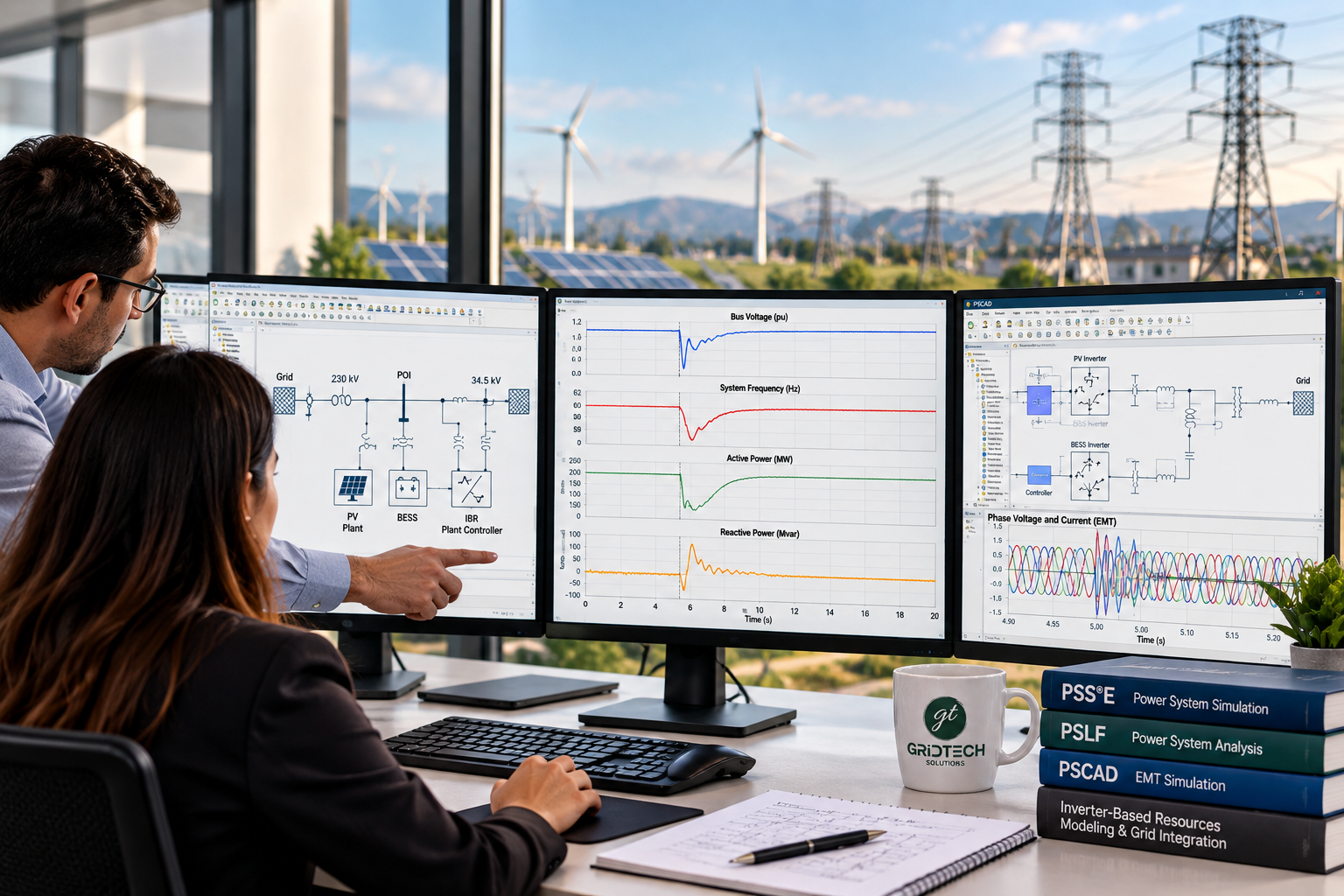
GridTech Solutions performs RMS and EMT simulations to evaluate inverter-based resource dynamic performance, control behavior, and response to grid disturbances. Our engineering assessments support IEEE 2800 performance evaluations, interconnection studies, and technical reviews by utilities and ISO/RTOs.
PSS®E and PSLF simulations for plant-level dynamic performance and control response.
PSCAD-based evaluation of converter controls, weak-grid interactions, and fast electrical transients.
Simulation of voltage and frequency disturbances, fault recovery, and plant response.
Evaluation of active power regulation, voltage control, reactive power response, and plant controller coordination.
Comparison of RMS and EMT simulation results to identify inconsistencies and model performance limitations.
Technical evaluation of model results against applicable performance criteria, including identification of potential control or parameter adjustments.
GridTech Solutions supports inverter-based resource owners, developers, utilities, and equipment manufacturers with model-based performance assessments, plant-level testing support, and technical verification activities. Our engineering services help evaluate resource performance against applicable IEEE 2800 requirements and support verification methodologies described in IEEE 2800.2.

Evaluate IBR performance using RMS and EMT simulations under defined operating conditions and grid disturbances.
Voltage and frequency ride-through simulations
Active and reactive power response verification
Fault recovery and dynamic performance
Plant controller and inverter coordination
Weak-grid and control interaction assessments
Simulation result comparison against applicable performance criteria
Support plant-level performance testing and verification activities using applicable IEEE 2800.2 methodologies and project-specific requirements.
Test plan and procedure development
Commissioning and field-testing coordination
Voltage and frequency response testing support
Active and reactive power control verification
Review of measured plant performance
Test evidence and conformity assessment documentation

Analyze testing and simulation results, identify performance gaps, and prepare engineering documentation for project stakeholders.
Measured versus simulated response comparisons
RMS and EMT model validation support
Identification of performance deviations
OEM coordination and corrective action recommendations
Technical reports and verification summaries
Utility and ISO/RTO technical review support
When an inverter-based resource does not demonstrate the expected technical performance, identifying the underlying cause is essential. GridTech Solutions performs detailed engineering assessments to evaluate performance deviations, investigate control interactions, and develop practical mitigation recommendations.
Our approach combines RMS and EMT simulations, technical model reviews, equipment and plant controller evaluations, and coordination with project stakeholders to support alignment with applicable IEEE 2800 performance requirements.
Voltage and frequency ride-through gap assessments
Inverter and plant controller performance reviews
Weak-grid and low-SCR stability investigations
Protection settings and control coordination
OEM model and parameter evaluation
Corrective action simulation and verification
Review simulation outputs, test evidence, and applicable technical performance criteria to identify deviations.
Evaluate inverter controls, plant controller settings, protection behavior, network conditions, and model assumptions.
Assess potential control adjustments, parameter tuning, protection coordination, and alternative engineering solutions.
Perform follow-up simulations or review testing results to evaluate the effectiveness of proposed corrective measures.
GridTech Solutions provides structured engineering support throughout the IEEE 2800 performance assessment process. Our approach combines applicable requirement reviews, technical modeling, simulation-based evaluations, testing support, and clear documentation to help project stakeholders understand performance expectations, identify potential gaps, and make informed engineering decisions.
Identify relevant IEEE 2800 performance requirements, project-specific interconnection criteria, and applicable utility or ISO/RTO expectations.
Review plant design information, inverter specifications, plant controller settings, protection data, and available RMS/EMT models.
Perform applicable power system simulations to evaluate voltage and frequency ride-through, active and reactive power controls, fault response, and dynamic performance.
Support relevant IEEE 2800.2-based verification activities, test procedure reviews, and comparison of available field measurements with simulation results.
Identify technical deviations, investigate potential causes, and evaluate engineering mitigation recommendations where needed.
Prepare assessment documentation, summarize technical findings, and support stakeholder review and resolution of technical comments.
IEEE 2800 applicability and requirements assessment matrix
RMS and EMT model review documentation
PSS®E, PSLF, and PSCAD simulation results, as applicable
Voltage and frequency ride-through assessment results
Active and reactive power control performance evaluations
RMS–EMT benchmarking and model verification summaries
Performance gap findings and mitigation recommendations
Final technical assessment report and utility/ISO/RTO review support
Final study scope, testing activities, and deliverables are tailored to applicable requirements, project characteristics, and available technical data.
TECHNICAL INTELLIGENCE
Explore technical guidance on NERC reliability standards, inverter-based resource compliance, model validation, and IEEE 2800 requirements.
From technical performance assessments and RMS/EMT simulations to testing support and engineering verification, GridTech Solutions helps developers, generation owners, and utilities evaluate applicable IEEE 2800 requirements and address potential performance gaps.
Discuss Your Project