
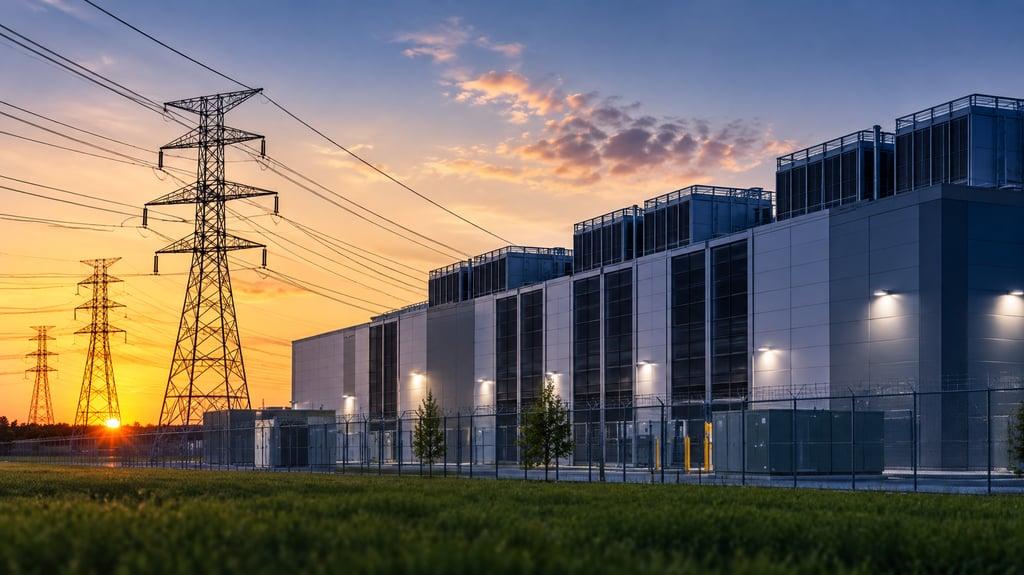

As Texas experiences rapid growth in AI data centers, hyperscale computing facilities, and other power-intensive developments, ERCOT is strengthening the technical requirements for large loads connected to its transmission system.
One of the most important developments is NOGRR282, which establishes voltage and frequency ride-through requirements for Large Computational Loads (LCLs).
Approved by the Public Utility Commission of Texas on July 9, 2026, and effective August 1, 2026, NOGRR282 and companion NPRR1308 represent an important change for data center developers, engineering consultants, and facility operators.
1. Why ERCOT Introduced NOGRR282
Unlike traditional industrial loads, modern data centers can contain substantial power-electronic equipment, including uninterruptible power supplies (UPS), rectifiers, and other electronically controlled systems.
These systems may disconnect rapidly during voltage or frequency disturbances.
When a large computational facility unexpectedly disconnects, the sudden loss of hundreds of megawatts of demand can create additional challenges for grid stability.
ERCOT introduced NOGRR282 to establish minimum ride-through performance requirements and reduce the risk of widespread load disconnections during transmission-system disturbances.
2. What Is a Large Computational Load?
NPRR1308 establishes the Large Computational Load classification within ERCOT's Large Load framework.
The classification addresses qualifying large facilities with substantial computational demand, including data centers and cryptocurrency mining operations.
Developers should evaluate both the facility's total demand and its computational-load characteristics against the applicable ERCOT definition.
Importantly, facilities should not assume that every large industrial load is automatically subject to the same requirements.
3. Key Ride-Through Requirements
Voltage Ride-Through
Qualifying facilities must demonstrate the ability to remain connected during specified voltage disturbances, subject to the applicable requirements and exceptions.
Engineering evaluations should consider:
- Voltage disturbances at the interconnection point.
- UPS and power-electronic equipment behavior.
- Undervoltage protection and equipment trip settings.
- Facility-level load disconnection during transmission faults.
- Recovery following fault clearing.
Frequency Ride-Through
Facilities must also satisfy applicable frequency ride-through requirements.
This requires reviewing the response of computational equipment, protection systems, and facility controls during grid-frequency deviations.
Protection and Control Coordination
A facility may have equipment capable of riding through a disturbance while its protection settings cause premature disconnection.
Therefore, compliance evaluations should address the coordination between equipment capabilities, facility protection, and overall load response.
4. Why Dynamic Modeling Matters
Ride-through compliance is not simply a matter of reviewing equipment specifications.
The behavior of a large computational facility depends on the interaction of its electrical equipment, controls, protection systems, and transmission network.
Depending on ERCOT and transmission service provider requirements, studies may involve:
- PSS®E dynamic modeling.
- Representation of power-electronic load behavior.
- Voltage and frequency disturbance simulations.
- Protection and control sensitivity assessments.
- Model quality and initialization testing.
- Assessment of aggregate facility load response.
Where detailed control interactions or fast electromagnetic phenomena are material, additional EMT analysis may be appropriate.
5. Existing Facilities and Exemptions
NOGRR282 includes exemption provisions tied to project status and specified milestones.
November 14, 2025, is an important date in the adopted exemption framework.
However, developers should not assume that a project qualifies for an exemption solely because development activities began before that date.
Eligibility depends on the specific conditions established in the approved rule language and supporting documentation.
6. Implications for Data Center Developers
NOGRR282 makes ride-through performance an important consideration during the planning and interconnection stages of qualifying projects.
Developers should coordinate early with their electrical engineering teams, equipment suppliers, transmission service providers, and ERCOT.
Potential challenges include:
- Insufficient equipment ride-through capability.
- Protection settings that cause unnecessary load trips.
- Incomplete dynamic models.
- Inconsistent equipment and facility-level assumptions.
- Late identification of design changes needed to satisfy performance requirements.
Addressing these issues early can reduce the risk of study delays and costly design modifications.
7. Developer Readiness Checklist
Before advancing a large computational load interconnection, developers should confirm:
- Applicability of NPRR1308 and NOGRR282 has been evaluated.
- Any claimed exemption is supported by the required documentation.
- Facility demand and computational-load characteristics are documented.
- Equipment ride-through capabilities have been obtained from manufacturers.
- Protection and control settings have been reviewed.
- Required dynamic models are available.
- Voltage ride-through performance has been assessed.
- Frequency ride-through performance has been assessed.
- Model quality and compatibility have been verified.
- ERCOT and transmission service provider study requirements have been reviewed.
- Any necessary corrective actions have been identified.
8. How GridTech Solutions Can Support Developers
GridTech Solutions provides engineering and consulting services for large-load interconnection and power-system modeling.
Our capabilities include:
- Large-load interconnection studies and application support.
- PSS®E dynamic model development and assessment.
- PSCAD/EMT modeling and simulation.
- Voltage and frequency ride-through studies.
- Protection and control coordination assessments.
- Technical evaluation of ERCOT modeling requirements.
Our goal is to help developers identify technical risks early and prepare reliable models and study packages for the interconnection process.
9. Official References
ERCOT NOGRR282 — Large Computational Load Ride-Through Requirements
ERCOT NPRR1308 — Related Large Computational Load Definition
ERCOT — Final Interim Voltage Ride-Through Assessment for Large Loads
Planning a data center or large computational load project in ERCOT?
Contact GridTech Solutions to discuss large-load modeling, interconnection studies, and ride-through performance assessments.
Email: info@gridtechsolution.com
Website: https://gridtechsolution.com
Technical note: This article provides a general engineering overview. Applicability, exemptions, required performance characteristics, and testing obligations should be confirmed against the approved ERCOT provisions and project-specific requirements.