
How ERCOT's new advanced grid support framework changes inverter controls, dynamic modeling, model quality testing, and BESS interconnection requirements
Updated November 04, 2026 | GridTech Solutions
Executive Summary
The Electric Reliability Council of Texas (ERCOT) has introduced a new advanced grid support (AGS) framework for inverter-based Energy Storage Resources (ESRs), establishing additional performance and modeling expectations for battery energy storage systems connecting to the ERCOT transmission grid.
Two coordinated revision requests establish the framework:
- NOGRR272: Establishes advanced grid support performance requirements through Section 2.14 of the ERCOT Nodal Operating Guides.
- PGRR121: Establishes associated model quality testing and unit model validation requirements through Section 6.2 of the ERCOT Planning Guide.
Both revisions received Public Utility Commission of Texas (PUCT) approval on November 6, 2025, and became effective December 1, 2025.
The requirements generally apply to transmission-connected ESRs with original Standard Generation Interconnection Agreements (SGIAs) executed on or after April 1, 2026. Certain capacity additions to existing ESRs are also covered.
For developers, the implications extend beyond selecting an inverter advertised as grid-forming capable. Projects must demonstrate the required dynamic characteristics using appropriate models, controls, simulations, and supporting technical evidence.
This article explains the regulatory framework, engineering principles, model validation considerations, and recommended approach for preparing an ERCOT BESS project.
1. Why ERCOT Introduced Advanced Grid Support
The ERCOT transmission system is undergoing significant changes as inverter-based generation, battery energy storage, and large electrical loads expand.
Traditional synchronous generators inherently contribute electromechanical characteristics associated with rotating machines, including a voltage source behind reactance and a physical relationship between rotor angle and system frequency.
Conventional grid-following inverters operate differently. They typically use a phase-locked loop (PLL) or other synchronization mechanism to track the grid voltage and inject controlled current.
As inverter-based resources become more prevalent, system performance increasingly depends on how inverter controls respond to disturbances, particularly under weak-grid conditions.
Relevant challenges include:
- Reduced system strength at some points of interconnection.
- Interactions among inverter controls, plant controllers, and network impedance.
- Voltage and phase-angle disturbances.
- Control instability following faults or transmission outages.
- Reduced availability of conventional synchronous generation.
- Increasing sensitivity to the dynamic behavior of inverter-based resources.
Advanced grid support is intended to improve the ability of eligible ESRs to support stable grid operation through appropriately designed inverter controls.
However, advanced grid support does not eliminate inverter current limits or guarantee stability under every possible network condition.
2. NOGRR272 and PGRR121: Understanding the Difference
Although the two revisions are closely related, they address different aspects of project compliance.
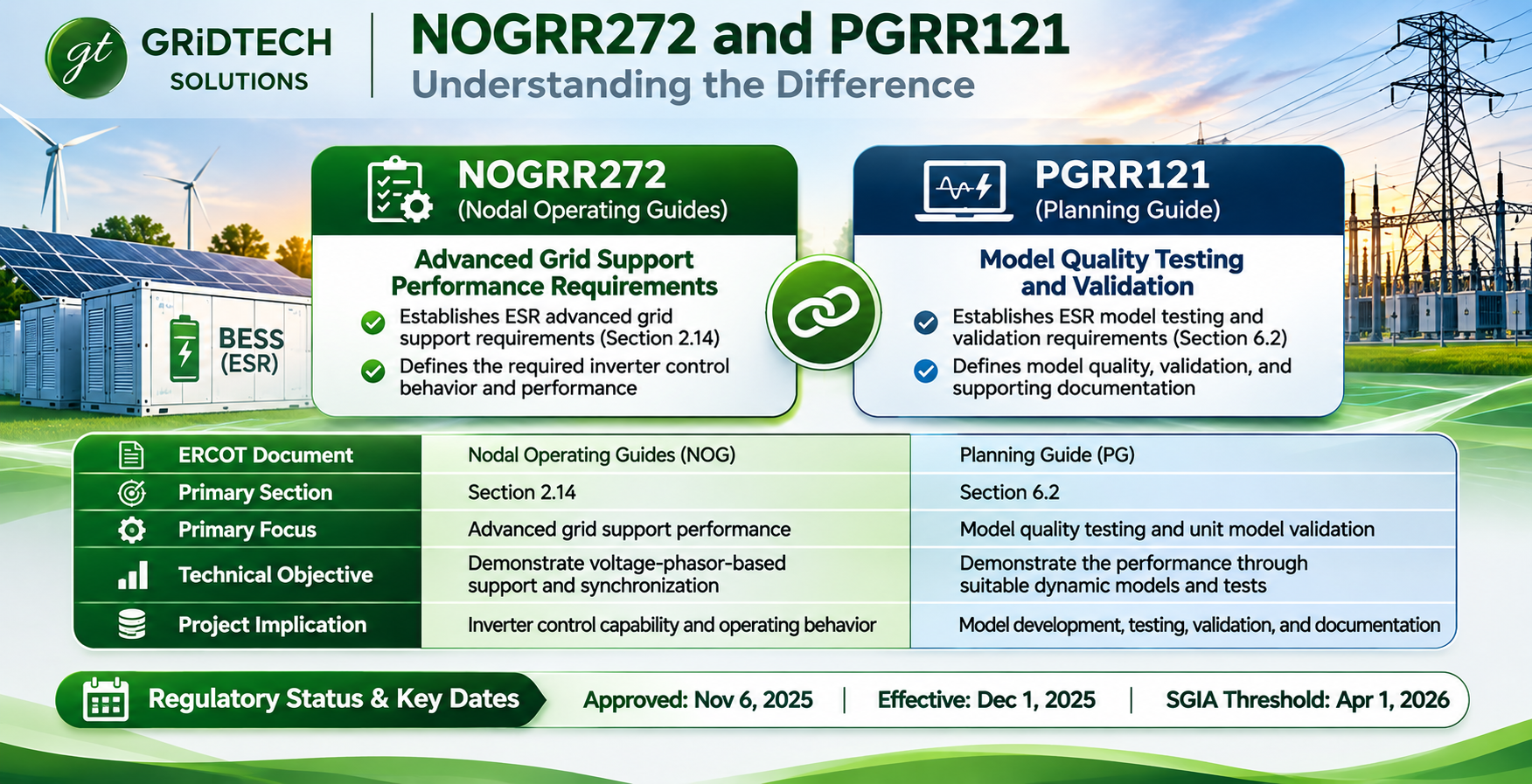
NOGRR272 establishes the underlying performance expectation.
PGRR121 provides the associated modeling and validation framework.
A successful engineering approach must consider both revisions together.
Regulatory applicability
ERCOT's framework generally applies to an ESR with an original SGIA executed on or after April 1, 2026.
An ESR with an original SGIA executed before that date is generally exempt from the Section 2.14 requirements for its existing capacity.
However, the requirements apply to portions of ESR modifications that add MW capacity on an aggregate nameplate basis on or after April 1, 2026.
Developers should therefore review the project's original SGIA, modification history, capacity additions, and applicable ERCOT requirements before assuming an exemption.
3. What Is Advanced Grid Support?
Advanced grid support refers to inverter capabilities that support grid stability through controlled voltage-phasor behavior.
ERCOT Section 2.14 requires applicable ESRs, when operating within inverter current limits, to demonstrate the capability to maintain an internal voltage phasor in the subtransient-to-transient timeframe and control that phasor to maintain synchronism with the ERCOT transmission grid.
This characteristic is commonly associated with grid-forming inverter technology.
A grid-forming inverter can establish and regulate an internal voltage reference rather than relying exclusively on the conventional grid-following approach of tracking the external grid voltage.
The exact implementation varies by manufacturer and control architecture.
Grid-following versus grid-forming behavior
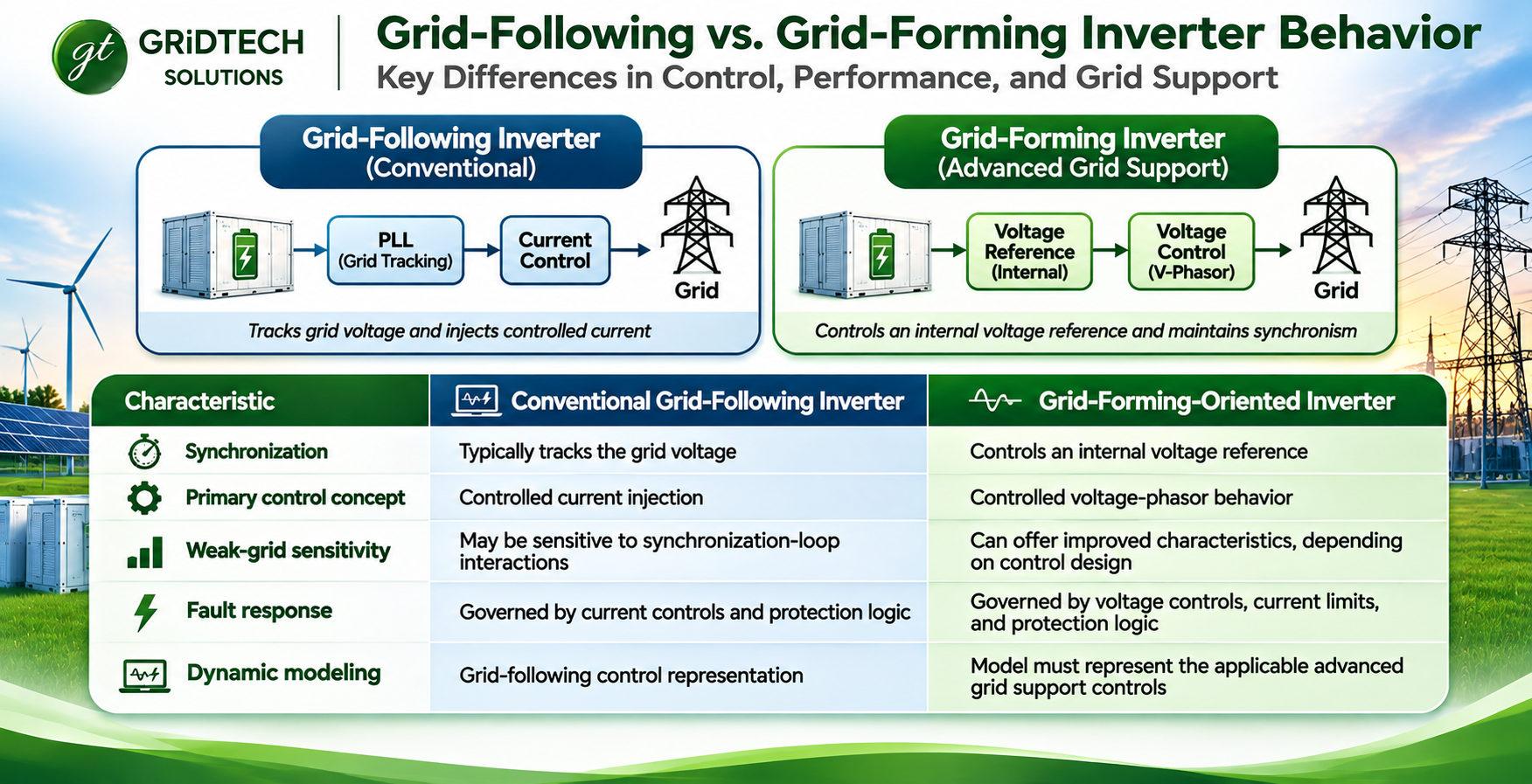
The distinction is functional rather than merely a product label.
An inverter described as grid-forming capable should not automatically be assumed to satisfy every ERCOT modeling and performance requirement.
Its implemented firmware, operating mode, plant controller, and validated model must represent the actual project configuration.
4. Advanced Grid Support and Inverter Current Limits
One of the most important technical qualifications in NOGRR272 is that the required advanced grid support behavior is subject to inverter current limits.
An inverter cannot provide unlimited active or reactive current during disturbances.
Its response is constrained by semiconductor ratings, converter protection, DC-side operating conditions, and control priorities.
For example, a simplified inverter current relationship is:
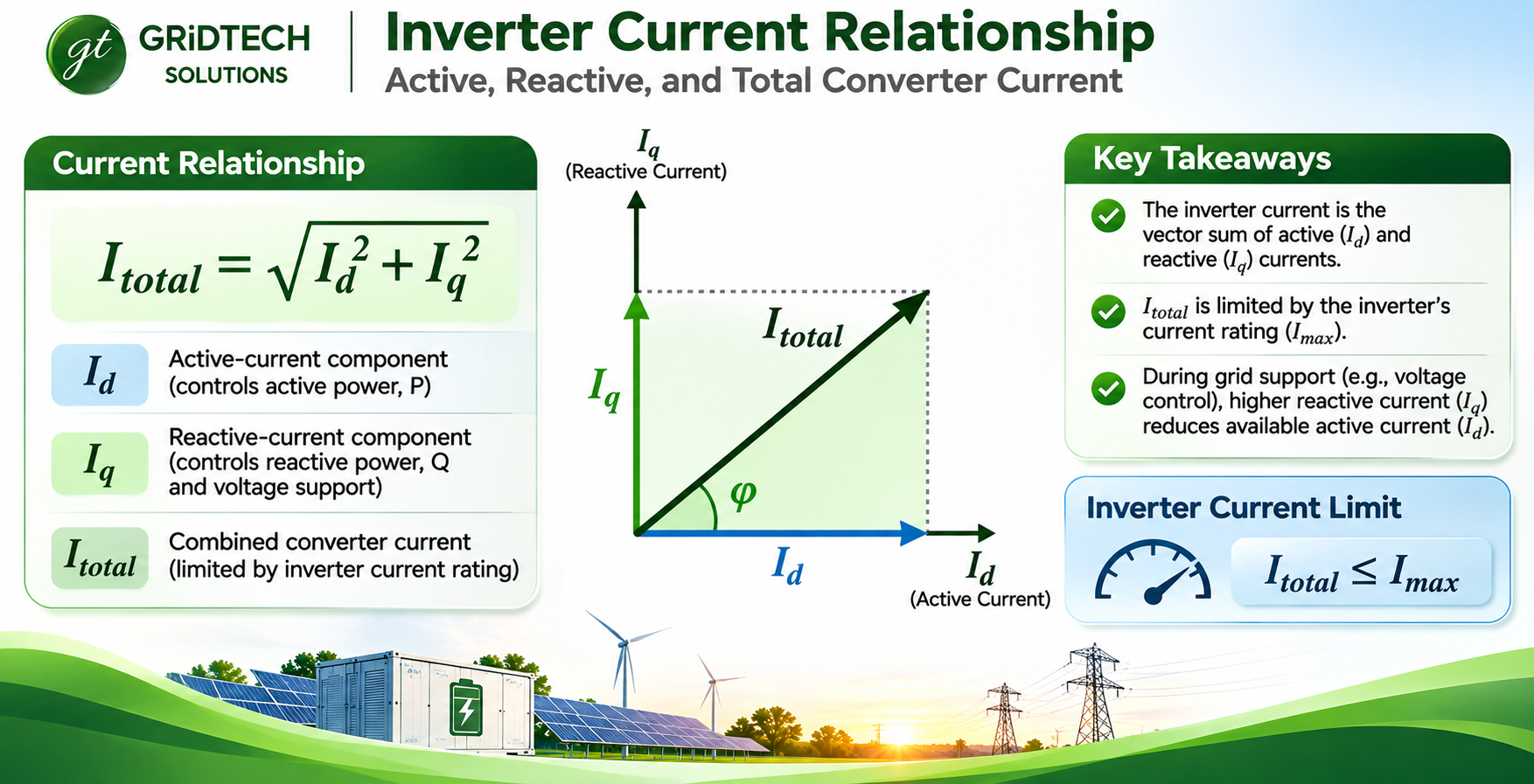
The controller must respect the applicable current capability.
During a voltage disturbance, reactive-current requirements, active-power control, and current saturation may interact.
These interactions should be represented appropriately in the dynamic model.
Engineering considerations
A project-level assessment should examine:
- Current limiting and saturation behavior.
- Active and reactive current prioritization.
- Internal voltage and phase-angle control.
- DC-link voltage constraints.
- Battery operating conditions and power limitations.
- Plant-level voltage and reactive power controls.
- Recovery behavior following disturbance clearance.
The appropriate representation depends on the actual equipment and the tests required by ERCOT.
5. PGRR121: Dynamic Model Quality Testing and Validation
PGRR121 introduces model quality testing and unit model validation requirements associated with advanced grid support.
The objective is to demonstrate that the submitted models adequately represent the applicable ESR technology and its intended control behavior.
Two important engineering activities are site-specific model quality testing and technology-specific unit model validation.
5.1 Site-specific model quality testing
Site-specific testing evaluates the behavior of the complete plant model under defined simulated disturbances.
The model should represent the relevant project equipment and control configuration, including:
- Inverter dynamic controls.
- Plant controller functions.
- Collector system representation.
- Main power transformer.
- Point of interconnection.
- Relevant control and protection limitations.
The purpose is to evaluate whether the project model produces physically reasonable responses and demonstrates the required advanced grid support characteristics.
5.2 Unit model validation
Unit model validation focuses on whether the inverter model accurately represents the equipment and control technology.
Validation may involve comparison against manufacturer testing, hardware measurements, or other accepted reference evidence.
Important considerations include:
- Control mode and firmware consistency.
- Voltage and frequency response.
- Active and reactive power response.
- Current limiting.
- Phase-angle behavior.
- Dynamic response during disturbances.
- Model performance across relevant operating conditions.
A model that passes a numerical simulation is not necessarily a validated representation of the installed inverter.
5.3 Model consistency
For projects requiring multiple simulation environments, engineering teams should evaluate consistency among the submitted models.
A common workflow uses:
- PSS®E: Positive-sequence dynamic simulations.
- PSCAD: Electromagnetic transient simulations.
- Manufacturer reference models or test data: Equipment-level validation.
- Project control documentation: Verification of implemented settings and operating modes.
The level of comparison and the required deliverables must follow the applicable ERCOT Planning Guide and supporting procedures.
6. Positive-Sequence and EMT Modeling Considerations
Advanced grid support introduces modeling challenges that may not be fully captured by simplified conventional inverter representations.
Positive-sequence simulations
Positive-sequence tools are commonly used for bulk-system transient stability studies.
They provide an efficient means of evaluating:
- Large transmission system disturbances.
- Active and reactive power response.
- Voltage recovery.
- Frequency response.
- Control interactions represented within the model's assumptions.
However, model suitability depends on whether the implemented model accurately represents the relevant grid-forming or advanced grid support behavior.
A conventional grid-following model should not be treated as an acceptable substitute solely because it can produce stable simulation results.
EMT simulations
Electromagnetic transient simulations can provide more detailed representations of fast inverter control interactions.
They are particularly valuable when studying:
- Low short-circuit ratio conditions.
- Fast voltage and phase-angle changes.
- Converter current limiting.
- Control transitions and saturation.
- Interactions among multiple inverter-based resources.
- Potential subsynchronous or other fast control interactions.
EMT modeling is especially useful when positive-sequence models cannot adequately represent the behavior under investigation.
Why weak-grid conditions matter
A weak grid generally has higher equivalent source impedance relative to the connected resource rating.
As the short-circuit ratio decreases, changes in inverter current can produce larger voltage and phase-angle variations at the point of interconnection.
These changes may interact with the inverter's synchronization, voltage, and current controls.
Advanced grid support can improve selected aspects of weak-grid performance, but its effectiveness must be demonstrated through appropriate studies.
7. Recommended Technical Assessment for ERCOT BESS Projects
The following workflow is an engineering recommendation for project readiness. It should not be interpreted as a substitute for ERCOT's prescribed test procedures.
Step 1 — Determine applicability
Review the original SGIA execution date, project configuration, and any capacity additions.
Step 2 — Confirm inverter capability
Obtain written confirmation from the inverter manufacturer regarding the available advanced grid support functions and supported firmware.
Step 3 — Identify required models
Confirm the required positive-sequence and EMT model deliverables, including the applicable model versions and validation documentation.
Step 4 — Review control architecture
Document the inverter control modes, plant controller functions, operating limits, and relevant protection settings.
Step 5 — Perform model quality testing
Run the applicable ERCOT-prescribed tests and document the results.
Step 6 — Complete model validation
Verify that the model represents the intended inverter technology and implemented controls.
Step 7 — Assess system integration
Evaluate the project under representative operating conditions, including relevant disturbances and weak-grid scenarios.
Step 8 — Prepare submission documentation
Organize model files, test results, assumptions, control descriptions, and supporting evidence for review.
Step 9 — Resolve deficiencies
Address model inconsistencies, control issues, or documentation gaps identified during the technical review.
Step 10 — Maintain configuration consistency
Ensure that the final model remains consistent with the equipment and settings ultimately installed at the project.
8. Implications for New and Existing BESS Projects
New projects
Developers with an original SGIA executed on or after April 1, 2026 should account for advanced grid support early in the equipment procurement and interconnection process.
Potential project impacts include:
- Inverter technology selection.
- Manufacturer capability verification.
- Model availability.
- Engineering study scope.
- Control configuration.
- Model testing and validation.
- Commissioning coordination.
Failure to consider these requirements early may result in additional engineering effort, equipment changes, or delays.
Existing projects
An existing ESR with an original SGIA executed before April 1, 2026 is generally exempt from the new Section 2.14 requirement for its existing capacity.
However, applicable MW capacity additions may trigger the requirements for the added portion.
Developers should not assume that an existing facility's exemption automatically extends to future expansions.
Hybrid solar-plus-storage facilities
For hybrid projects, the applicability of the advanced grid support requirements must be evaluated against the ESR configuration, applicable agreements, and project-specific interconnection arrangements.
The presence of solar generation does not automatically make the entire hybrid plant subject to the same advanced grid support obligation.
A project-specific regulatory and modeling review is appropriate.
9. Common Engineering Challenges
Challenge 1 — Model does not represent the installed control mode
A model may contain advanced grid support functions that are not enabled in the actual inverter configuration.
Recommended approach: Verify firmware, operating mode, model parameters, and manufacturer documentation.
Challenge 2 — Stable response in one model but instability in another
Differences between positive-sequence and EMT results can arise from model fidelity, control assumptions, initialization, or parameter inconsistencies.
Recommended approach: Review the models under comparable operating conditions and identify the physical causes of significant discrepancies.
Challenge 3 — Current limiting affects voltage support
The inverter may reach its current limit during severe disturbances, changing the expected voltage response.
Recommended approach: Examine current limiting, active/reactive current allocation, and recovery behavior.
Challenge 4 — Plant controller conflicts with inverter controls
Plant-level voltage or reactive power controls may interact with inverter-level voltage regulation.
Recommended approach: Evaluate controller coordination, response times, limits, and operating modes.
Challenge 5 — Weak-grid control interactions
Advanced grid support does not guarantee that every inverter configuration will remain stable at very low short-circuit ratios.
Recommended approach: Perform project-specific stability studies using appropriate network representations and validated control models.
10. Frequently Asked Questions
Does ERCOT require all existing battery energy storage systems to implement advanced grid support?
No. The framework generally exempts existing ESR capacity covered by an original SGIA executed before April 1, 2026. Applicable capacity additions on or after that date may be subject to the requirements.
Is advanced grid support the same as grid-forming inverter technology?
ERCOT's advanced grid support framework is closely associated with grid-forming characteristics. However, compliance depends on demonstrating the required behavior, not merely using a product marketed as grid-forming.
Does NOGRR272 require an ESR to maintain unused inverter headroom at all times?
ERCOT's published technical FAQ explains that the proposed framework did not require ESRs to maintain headroom continuously during real-time operation. The required capability is evaluated within the available inverter operating limits. Developers should confirm the applicable final requirements and operating obligations.
Is a PSCAD model required?
The applicable ERCOT modeling requirements determine the required submissions and tests. Projects should verify the current Planning Guide Section 6.2 requirements and supporting procedures rather than assume that a generic inverter model is sufficient.
Can a conventional grid-following inverter satisfy NOGRR272?
A conventional grid-following model or product designation alone does not demonstrate the required advanced grid support capability. The actual inverter controls must demonstrate the specified voltage-phasor behavior through the applicable testing framework.
Why is model validation important?
Validation helps establish that simulation results represent the actual inverter technology and control implementation. Without adequate validation, a stable simulated response may not accurately predict field performance.
Are solar and wind projects automatically subject to NOGRR272?
The mandatory framework established by NOGRR272 focuses on applicable ESRs. Other inverter-based technologies may be affected by separate requirements or future initiatives, but they should not automatically be classified as subject to this ESR-specific obligation.
11. How GridTech Solutions Supports Advanced Grid Support Studies
GridTech Solutions provides power system modeling, simulation, and interconnection engineering services for inverter-based generation and energy storage projects.
Relevant engineering services include:
- ERCOT interconnection application and study support.
- PSS®E positive-sequence model development and evaluation.
- PSCAD EMT model assessment.
- Inverter model quality testing.
- Model validation and benchmarking.
- Weak-grid and short-circuit ratio assessments.
- Transient stability and disturbance-response analysis.
- Plant controller coordination assessments.
- Model troubleshooting and technical documentation.
- Pre-commissioning and post-commissioning engineering support.
Our approach focuses on identifying technical issues early, verifying model consistency, and supporting reliable integration of battery energy storage resources into the transmission system.
Planning an ERCOT BESS project?
Contact GridTech Solutions to discuss advanced grid support modeling, interconnection studies, and engineering support.
Email: info@gridtechsolution.com
12. Conclusion
ERCOT NOGRR272 and PGRR121 establish an important development in the technical expectations for inverter-based energy storage resources.
The revisions combine advanced grid support performance requirements with a supporting framework for dynamic model quality testing and validation.
For developers, the central challenge is not simply obtaining a grid-forming-capable inverter. It is demonstrating that the complete project configuration, including inverter controls, plant controls, operating limits, and submitted models, satisfies the applicable ERCOT requirements.
Early coordination among developers, equipment manufacturers, modeling engineers, and interconnection stakeholders can reduce technical uncertainty and improve project readiness.
Official References
- ERCOT NOGRR272 — Advanced Grid Support Requirements for Inverter-Based ESRs
- ERCOT PGRR121 — Related to NOGRR272
- ERCOT Nodal Operating Guides
- ERCOT Advanced Grid Support ESR Functional Specification and Test Requirements
- ERCOT Advanced Grid Support ESR Frequently Asked Questions
Regulatory note: This article provides an engineering interpretation of the identified ERCOT requirements. Project-specific compliance must be evaluated using the applicable approved ERCOT documents, procedures, and interconnection agreements.