

The reliability of our Bulk Power System (BPS) is paramount, and at Gridtech Solutions, we're keenly focused on the standards that underpin this reliability. A significant development on the horizon (with expected adoption in November 2025) is the updated NERC Reliability Standard MOD-026-2, now explicitly titled "Verification and Validation of Dynamic Models and Data". This standard is not just another compliance checkbox; it's a critical step towards enhancing the accuracy of models used to assess and maintain grid stability.
This update strengthens requirements for Generator Owners (GOs), Transmission Owners (TOs), Planning Coordinators (PCs), and Transmission Planners (TPs) to provide verified and validated models that reflect real-world system performance.
Why MOD-026-2 Matters More Than Ever
The evolving complexity of the BPS, with the increasing integration of inverter-based resources (IBRs) and other dynamic technologies, necessitates highly accurate and validated models. MOD-026-2 aims to ensure that the dynamic models and associated parameters of in-service equipment accurately reflect their real-world behavior, which is essential for effective system planning and operation.
Applicability: Who Must Comply?
This standard has broad applicability across the energy sector, impacting various functional entities and facility types. It applies to:
Functional Entities:
🔹 Generator Owners (GO)
🔹 Transmission Owners (TO)
🔹 Planning Coordinators (PC)
🔹 Transmission Planners (TP)
Facility Types:
🔹 Individual generating resources and generating plants (as defined by BES Inclusion 12).
🔹 Dynamic reactive resources with a gross nameplate rating greater than 20 MVA, including Synchronous condensers and Flexible Alternating Current Transmission System (FACTS) devices.
🔹 High-voltage direct current (HVDC) terminal equipment, specifically Line Commutated Converters (LCC) and Voltage Source Converters (VSC).
🔹 BES Inverter-Based Resources (IBRs) and Non-BES IBRs with an aggregate nameplate capacity equal to or greater than 20 MVA connected at 60 kV or greater.
Key Updates and Definitions in the Latest Draft
The current draft of MOD-026-2, released for its initial 26-day formal comment period and ballot from May 22 to June 16, 2025, introduces crucial clarifications:
- Model Verification: This refers to the static process of checking documents and files, comparing them to model parameters, model structure, or equipment settings to ensure the model represents the equipment design and settings.
- Model Validation: This describes the dynamic process of testing or monitoring in-service equipment behavior and then comparing those results to the model's simulated response.
These distinct definitions underscore the comprehensive approach required for ensuring model accuracy.
Detailed Requirements for Model Submissions
The standard lays out specific requirements for entities to provide verified models and accompanying information to their Transmission Planner:
- Positive Sequence Dynamic Models: For synchronous generation, synchronous condensers, IBRs, FACTS devices, and HVDC, entities must provide verified positive sequence dynamic models and associated parameters. This includes detailed information such as the manufacturer, model number, software/firmware version, and documentation of validation using recorded data from staged tests or system disturbances.
- Electromagnetic Transient (EMT) Models: For IBRs, FACTS, and HVDC, verified EMT models are also required. These submissions must include attestations from Original Equipment Manufacturers (OEMs) and device test results that demonstrate a comparison of the IBR unit's response and the EMT model response for large signal disturbances.
- Protection Systems and Controls: Models must represent enabled Protection Systems that directly trip or limit active/reactive output of the equipment, including over/under-voltage, over/under-frequency, and overcurrent protections.
- Periodic Updates: Any changes to in-service equipment (hardware, software, firmware, control mode, or settings) that alter its response characteristics necessitate an updated verified model or a mutually agreed-upon plan with the Transmission Planner within specified timeframes.
- Transmission Planner Review: Transmission Planners are required to review submitted models and provide acceptance or denial notifications, with explanations and supporting evidence, within 90 calendar days.
Requirements and Measures
MOD-026-2 includes six requirements (R1–R7) with measures (M1–M7):
- R1: Transmission Planners (TPs) and Planning Coordinators (PCs) develop model verification requirements, including positive sequence and electromagnetic transient (EMT) model specifications.
- R2: Generator/Transmission Owners provide verified positive sequence models per Attachment 2 periodicity.
- R3: Owners submit verified EMT models for IBRs, FACTS, and HVDC systems, including OEM attestations and comparison with staged tests.
- R4: Owners update models within 180 days of equipment changes affecting dynamic response.
- R5: Transmission Planners review submissions within 90 days, issuing acceptance or denial notifications.
- R6: Owners respond to denials or review requests within 90-180 days with updated models or plans.
- R7: TPs must provide current models to GOs/TOs within 90 days of request.
Attachments: Key Technical Requirements
Attachment 1: What Must Be Modeled
- Generators/synchronous condensers: excitation, governor, stabilizers, protection (OV, UV, OF, UF, volts/Hz, out-of-step).
- IBRs/FACTS/HVDC: Volt/VAR, frequency/power controls, plant controllers, limiting and protective functions (active/reactive limits, ride-through, post-disturbance recovery).
Attachment 2: Periodicity Rules
- Initial submission: within 365 days of operation or effective date.
- Subsequent updates: every 10 years or after major changes.
- Special cases:
- Units with <5% capacity factor may be exempted.
- Facilities without frequency/voltage response must document exemptions.
- Equivalent synchronous units ≤350 MVA can rotate validation among units.
Compliance Monitoring & Enforcement
- Evidence Retention: R1–R7 records must be retained since the last audit (typically 3+ years).
- CMEP Oversight: NERC & Regional Entities enforce through audits.
- Violation Severity Levels (VSLs):
- Late submissions (91–270+ days) increase severity.
- Missing required protections/models = higher violation risk.
- Non-response to Transmission Planner requests = severe violation.
Transition From MOD-026-1 and MOD-027-1
It’s important to note that MOD-026-1 and MOD-027-1 remain enforceable during the transition period.
🔹 MOD-026-1 covers verification of generator excitation and plant volt/var control models.
🔹 MOD-027-1 covers turbine governor and frequency/load control models.
Both must still be maintained for compliance until MOD-026-2 is fully implemented. This ensures that key excitation, governor, and plant controller validations remain in place while entities prepare for the expanded modeling requirements of MOD-026-2.
Transition Timeline
The chart below shows how MOD-026-1 and MOD-027-1 overlap with the new MOD-026-2 standard:
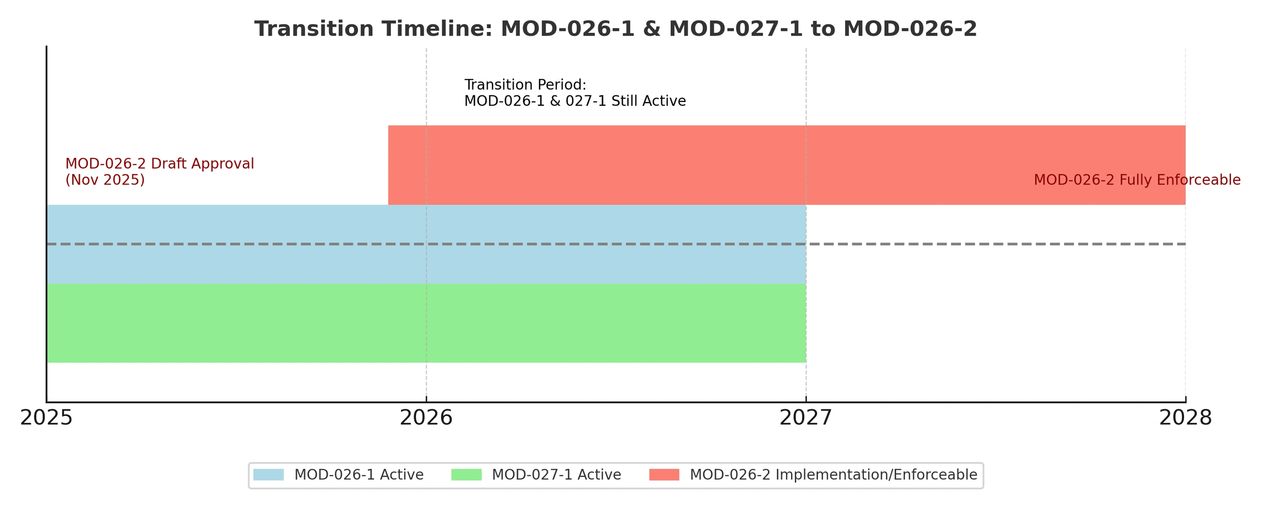
This transition period means that Generator Owners, Transmission Planners, and other applicable entities must be able to demonstrate compliance with both sets of standards until MOD-026-2 is fully enforceable.
How GridTech Solutions Supports MOD-026-2 Compliance
The complexities of NERC MOD-026-2 require a thorough understanding of dynamic modeling, validation, and compliance processes. With decades of experience in model validation through NERC MOD-026 and MOD-027, along with extensive expertise in PSCAD model development, we can help you create and validate your PSSE, PSLF, PSCAD, and TSAT models. GridTech Solutions offers expert support to navigate MOD-026-2 compliance:
🔹 Model Development: Assist in creating and verifying positive sequence and EMT models.
🔹 Validation Services: Conduct tests and validations to meet R2 and R3 requirements.
🔹 Compliance Consulting: Guide entities through documentation, submission, and response processes.
🔹 Training: Provide workshops on model verification and regulatory compliance.
🔹 Technology Solutions: Offer tools to streamline model management and updates.
NERC MOD-026-2 raises the bar for dynamic model verification and validation across the Bulk Power System. By complying with its rigorous requirements, entities can:
🔹 Enhance grid reliability
🔹 Support renewable integration
🔹 Avoid costly penalties
🚀 Partner with GridTech Solutions to streamline MOD-026-2 compliance, from model development through validation and audit preparation.
📞 Contact us: 501-298-4400
✉️ Email: info@gridtechsolution.com
Stay Updated!
🔔 Subscribe to our newsletter for more insights on grid reliability standards.
📢 Follow us on LinkedIn for updates on grid standards.