
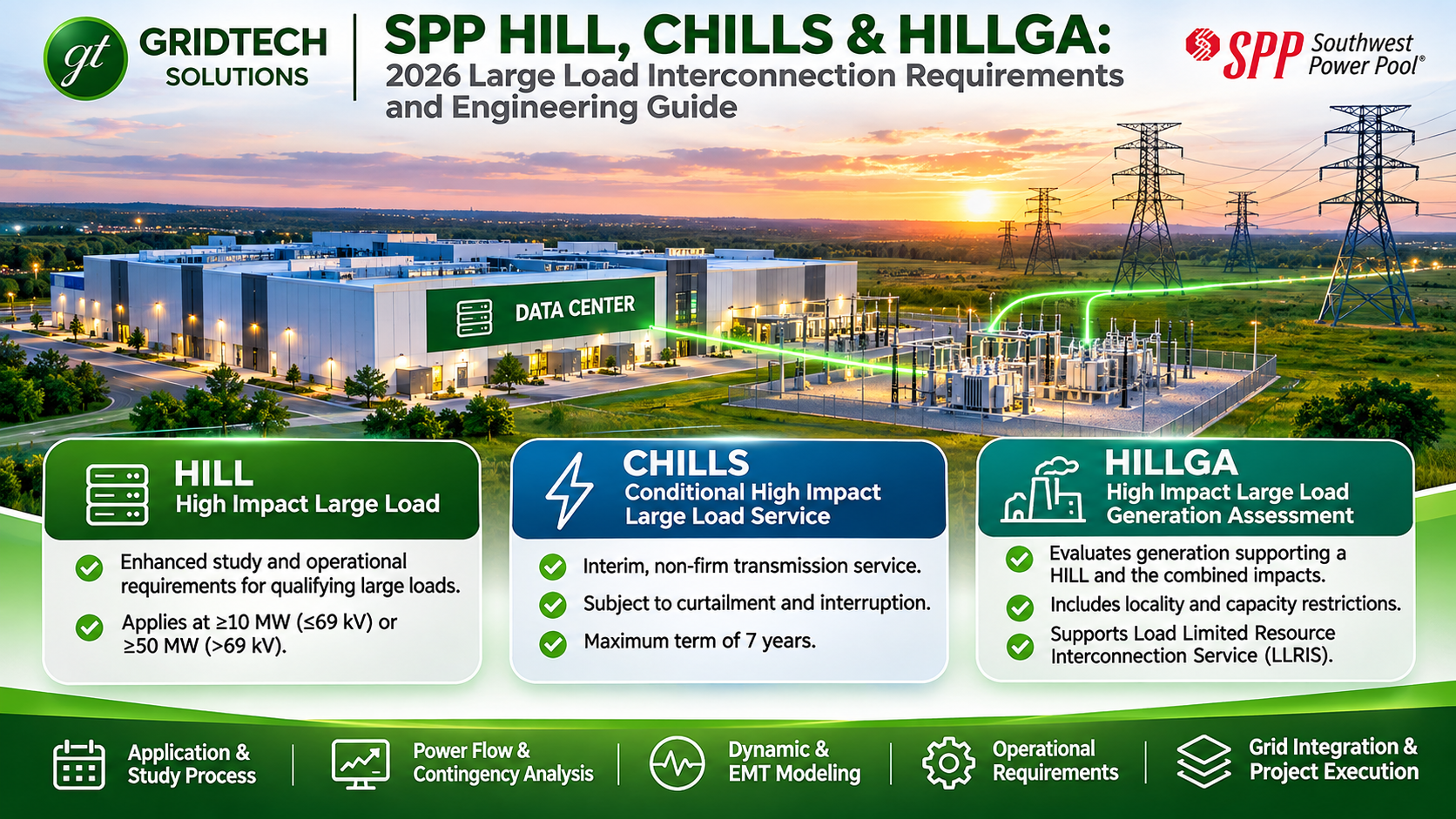
Understanding Southwest Power Pool's high-impact large load framework, conditional transmission service, generation assessment, and engineering study requirements
Updated November 25, 2026 | GridTech Solutions
Executive Summary
Southwest Power Pool (SPP) has introduced a new framework for evaluating and integrating high-impact large loads, including hyperscale data centers, artificial intelligence computing facilities, advanced manufacturing, and large industrial developments.
The framework is designed to improve coordination among transmission service, delivery point assessments, generation interconnection, and grid reliability evaluations.
Three closely related mechanisms are particularly important:
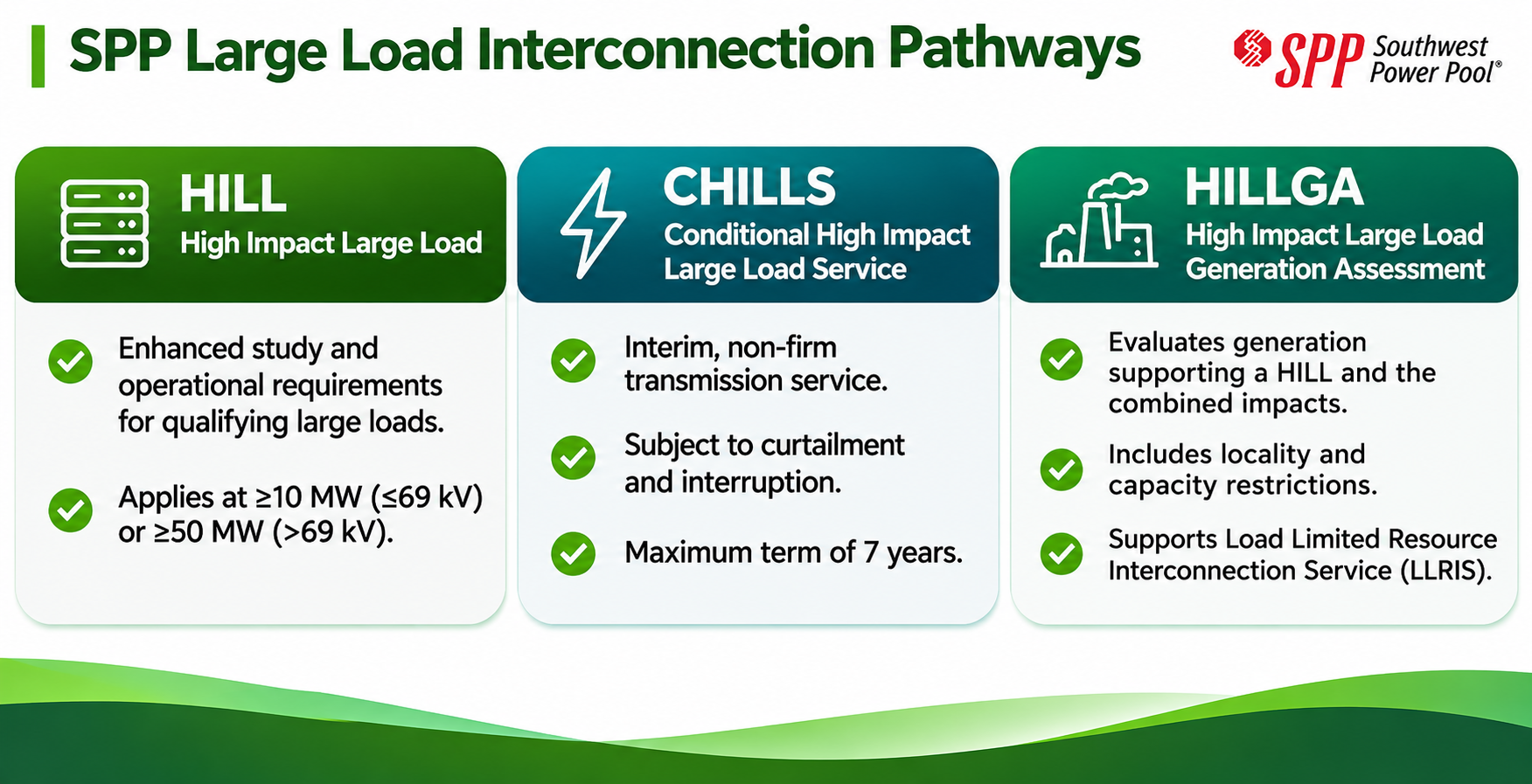
- High Impact Large Load (HILL): Establishes enhanced study and operational requirements for qualifying large loads.
- Conditional High Impact Large Load Service (CHILLS): Provides an interim, non-firm transmission service option subject to curtailment and interruption.
- High Impact Large Load Generation Assessment (HILLGA): Evaluates proposed generation intended to support an associated large load.
The Federal Energy Regulatory Commission (FERC) accepted SPP's HILL and HILLGA tariff revisions effective January 15, 2026. CHILLS was subsequently accepted in June 2026.
These developments create new opportunities for developers seeking to connect large electrical loads to the SPP transmission system. However, faster study pathways do not eliminate transmission constraints, engineering requirements, operating limitations, or the need for adequate electrical infrastructure.
For project developers, success depends on selecting the appropriate interconnection pathway, preparing accurate load and generation models, evaluating system impacts, and coordinating the technical and commercial requirements early in project development.
1. What Is a High Impact Large Load in SPP?
SPP defines a High Impact Large Load as a new commercial or industrial load, or an increase in an existing load, at a single site connected through one or more shared points of interconnection or delivery points that meets either of the following thresholds:
Transmission connection voltage Qualifying load
69 kV or below 10 MW or greater
Above 69 kV 50 MW or greater
These thresholds are particularly relevant for data center campuses, manufacturing facilities, semiconductor plants, and other developments requiring substantial electric power.
Example: 200 MW data center
Consider a proposed 200 MW data center connected at 345 kV.
Because its requested load exceeds the 50 MW threshold for connections above 69 kV, it would qualify as a HILL, assuming the remaining definition and applicability conditions are satisfied.
The developer would need to address the applicable HILL study and operational requirements.
The appropriate study pathway would depend on the proposed transmission service, designated resources, delivery point configuration, and any supporting generation.
Why the HILL designation matters
A HILL may produce system impacts that differ significantly from those of conventional commercial loads.
Potential concerns include:
- Large changes in transmission loading.
- Voltage stability and reactive power requirements.
- Fault-related load behavior.
- Rapid load increases and decreases.
- Power electronic equipment interactions.
- Contingency-related voltage recovery.
- Interactions with nearby generation.
- System operating limitations.
SPP's framework addresses these concerns through enhanced studies, data requirements, and operational safeguards.
2. HILL, CHILLS, and HILLGA: Understanding the Differences
Although these mechanisms are related, they serve different purposes.
2.1 HILL — High Impact Large Load
The HILL process establishes enhanced assessment and operating requirements for qualifying loads.
SPP identifies different study pathways depending on whether the transmission customer has sufficient Designated Resources to serve the proposed load.
Applicable tariff processes include Attachment AQ and Attachment AX.
The resulting engineering assessment is intended to identify transmission system impacts, required improvements, and reliability considerations.
2.2 CHILLS — Conditional High Impact Large Load Service
CHILLS is an interim, non-firm transmission service mechanism.
It allows eligible large loads to receive energy on an as-available basis while awaiting sufficient designated resources or transmission upgrades needed for long-term firm service.
The service is subject to interruption and curtailment.
Its maximum duration is seven years.
CHILLS can offer a development option for customers whose electrical demand is flexible enough to accommodate operating restrictions.
However, a data center requiring uninterrupted electrical service must carefully evaluate the operational and commercial implications of non-firm service.
2.3 HILLGA — High Impact Large Load Generation Assessment
HILLGA evaluates generation proposed to support an associated HILL.
The process considers:
- The proposed large load.
- The proposed generating facility intended to follow that load.
- The combined load and generation configuration.
This coordinated assessment can help determine whether the generation and load can be integrated reliably under the applicable operating restrictions.
HILLGA does not automatically authorize unrestricted generator exports to the SPP transmission system.
3. Understanding SPP's 90-Day Study Framework
SPP has described an expedited study-and-approval framework that can provide a path toward interconnection agreements in approximately 90 days for eligible projects.
This is an important development compared with traditional, sequential study processes.
However, developers should distinguish among:
- Study completion.
- Interconnection agreement execution.
- Transmission service authorization.
- Completion of network upgrades.
- Physical energization.
- Commercial operation.
These are separate project milestones.
A 90-day study pathway should not be interpreted as a guarantee that a 200 MW or 500 MW data center can physically energize within 90 days.
Actual energization depends on transmission infrastructure, study results, construction, equipment procurement, contractual arrangements, and operational readiness.
Engineering implications
A successful accelerated study requires complete and consistent technical information.
Incomplete load models, uncertain project configuration, or inconsistent generation assumptions can delay the evaluation.
Developers should therefore complete substantial engineering preparation before submitting the application.
4. HILL Application and Technical Data Requirements
The precise submission requirements depend on the applicable tariff attachment and SPP's current submission guidelines.
Developers should begin by preparing a comprehensive technical data package.
4.1 Project identification and configuration
Relevant information typically includes:
- Project name and location.
- Transmission owner and proposed delivery point.
- Requested MW demand.
- Proposed voltage level.
- Initial and ultimate project capacity.
- Development phases and energization schedule.
- Single-line diagrams.
- Proposed substation and transformer configuration.
4.2 Electrical load characteristics
The engineering team should identify:
- Maximum and minimum demand.
- Expected load profile.
- Power factor.
- Reactive power requirements.
- Load ramping characteristics.
- Voltage sensitivity.
- Frequency sensitivity.
- Major equipment categories.
- Protection and disconnection behavior.
4.3 Dynamic load characteristics
For large data centers, the electrical behavior of power-electronic equipment can be particularly important.
Relevant equipment may include:
- Uninterruptible power supplies.
- Rectifiers and inverters.
- Server power supplies.
- Variable-frequency drives.
- Chillers and cooling systems.
- Battery-backed equipment.
- On-site power conditioning equipment.
The selected load model should reflect the actual equipment technology rather than assuming the entire facility behaves as a conventional static load.
4.4 Supporting generation
Where the project includes on-site or nearby generation, the submission should clearly identify:
- Generation technology.
- Installed capacity.
- Proposed point of interconnection.
- Relationship to the associated load.
- Operating mode.
- Generation ramping and dispatch behavior.
- Export limitations.
- Protection and control arrangements.
SPP's official HILL Characteristics Form and submission guidelines should be used to determine the final required data package.
5. Power Flow and Contingency Analysis
Power flow studies evaluate the steady-state effect of connecting a large electrical load to the transmission system.
For a proposed HILL, the analysis may examine:
- Transmission line loading.
- Transformer loading.
- Bus voltage profiles.
- Reactive power flows.
- Transmission losses.
- System transfer limitations.
- Required transmission improvements.
Base-case evaluation
The proposed load is incorporated into representative SPP network models.
Different load levels and generation dispatch conditions may produce materially different results.
For example, a 300 MW data center may have acceptable voltage performance under one dispatch condition but cause voltage or thermal violations under another.
Contingency analysis
Contingency studies assess the response of the transmission network to outages of selected facilities.
Potential concerns include:
- Overloading of remaining transmission lines.
- Transformer thermal violations.
- Low-voltage conditions.
- Increased reactive power demand.
- Loss of acceptable transmission service capability.
The applicable contingency definitions and performance criteria must follow SPP's governing planning and study requirements.
Point of interconnection screening
Early screening of multiple candidate delivery points can help identify locations with comparatively favorable transmission capacity.
However, screening is preliminary and does not replace SPP's formal study process.
6. Short-Circuit and Protection Considerations
Connecting a large load may require changes to the transmission delivery system, including new substations, transformers, and switching equipment.
Short-circuit analysis can help determine whether the proposed configuration affects:
- Available fault current.
- Equipment interrupting ratings.
- Transformer and bus fault duty.
- Protection coordination.
- Grounding requirements.
- Relay settings.
- Protection system performance.
Large facilities with substantial motor loads or on-site generation may contribute additional fault current.
Inverter-based equipment behaves differently from conventional rotating machines, and its fault response depends on control and protection characteristics.
The appropriate short-circuit representation should reflect the installed equipment and the applicable study methodology.
7. Dynamic Stability and Load Ride-Through
Steady-state studies alone may not fully characterize the behavior of a large data center or industrial facility.
Dynamic studies can evaluate the interaction between the facility and the transmission system following disturbances.
Important considerations include:
- Voltage recovery after faults.
- Frequency response.
- Load disconnection and reconnection.
- Large-load ramping.
- Motor stalling and recovery.
- Reactive power response.
- Interactions with nearby generation.
- Post-contingency stability.
Load ride-through
SPP's HILL framework includes ride-through-related operational requirements.
Developers should review the applicable High Impact Large Load Ride-Through Requirements Manual and determine the performance expected of their facility.
A load that disconnects abruptly during a voltage disturbance can produce significant system effects, especially when several large facilities respond similarly.
Dynamic model quality
The model should adequately represent the physical equipment and control behavior relevant to the study.
Where necessary, the modeling approach may include:
- Composite load representations.
- Motor models.
- Power-electronic load components.
- User-defined models.
- Equipment-specific dynamic models.
- Site-level control logic.
The selected model must be technically justified and compatible with the applicable study environment.
8. EMT Modeling for Large Data Centers
Electromagnetic transient studies can be valuable when fast control interactions or detailed power-electronic behavior are important.
For example, a large data center may contain multiple converter-based systems that interact with one another and with the surrounding transmission network.
Potential EMT study topics include:
- Converter control interactions.
- Weak-grid operation.
- Fault-induced control transitions.
- Voltage recovery.
- Fast reactive power response.
- Interactions between UPS systems and on-site generation.
- Protection and control response.
EMT studies should be performed where required by SPP or justified by the project-specific technical risks.
Not every large load automatically requires the same EMT study scope.
PSS®E and PSCAD model consistency
Where both positive-sequence and EMT models are used, engineering teams should review whether they represent consistent operating conditions and equipment behavior.
Differences in control assumptions, initialization, or model fidelity can produce materially different results.
Model comparison and validation can help identify these inconsistencies before formal submission.
9. HILLGA and Load Limited Resource Interconnection Service
A major feature of the HILLGA framework is the ability to evaluate generation intended to serve an associated HILL.
This arrangement is especially relevant for large data centers considering dedicated gas-fired generation, battery storage, or other supporting resources.
Load Limited Resource Interconnection Service
Load Limited Resource Interconnection Service (LLRIS) provides a mechanism under which generation is limited in relation to the demand of the associated large load.
The objective is to support the load without creating unrestricted incremental generation exports.
This can reduce certain transmission impacts compared with a conventional generator interconnection that seeks broader export capability.
However, the arrangement requires careful control and operational coordination.
Example: 500 MW data center with supporting generation
Consider a 500 MW data center paired with a 500 MW generating facility.
The engineering assessment must consider more than the nominal equality of the two ratings.
Relevant operating scenarios include:
- Full load and full generation.
- Full load and partial generation.
- Load reduction while generation remains online.
- Sudden generator outage.
- Sudden load disconnection.
- Generation ramping.
- Emergency operating conditions.
- Export-limiting control response.
A generation-to-load capacity match does not eliminate the need for dynamic and contingency assessments.
HILLGA locality and capacity restrictions
SPP's tariff establishes specific requirements concerning the location and capacity of generation proposed under HILLGA.
For example, the tariff includes criteria for determining whether generation is in the same local area as the associated load.
It also limits the accredited capacity associated with HILLGA requests using a formula based on the HILL request and the applicable planning reserve margin.
These requirements must be evaluated using the controlling tariff provisions and the specific project configuration.
10. Operational Requirements for High Impact Large Loads
SPP's HILL framework includes ongoing operational obligations intended to protect transmission system reliability.
The published tariff framework identifies requirements addressing:
- Non-conforming load treatment.
- Real-time telemetry.
- Remote disconnection capability.
- Load ramp-rate limitations.
- Phasor measurement unit installation.
- Ride-through performance.
- Appropriate transmission service for withdrawals.
These requirements can affect facility electrical design, control systems, communications, and commissioning plans.
Telemetry and communications
The facility may need to provide operating information to the relevant system operator.
Engineering planning should consider metering, communications reliability, data quality, and required signal availability.
Remote disconnection
The applicable remote-disconnection requirements should be incorporated into the facility's control and protection design.
Developers should coordinate the technical implementation with the transmission owner and SPP.
Ramp-rate limitations
Rapid changes in large-load demand can affect system balancing and transmission conditions.
The facility's operational strategy should consider applicable ramp-rate restrictions, including how those restrictions interact with phased energization, computing demand, cooling systems, and on-site generation.
Ride-through performance
The facility should be evaluated for the required response to transmission system voltage and frequency disturbances.
This may require coordination among UPS controls, load protection, site controllers, and generation controls.
11. CHILLS: Benefits and Risks of Conditional Service
CHILLS can provide an alternative for developers willing to accept non-firm transmission service.
The principal benefit is the potential to access available transmission capability while awaiting longer-term arrangements.
However, the service includes material limitations.
Benefits
- Potential interim access to available transmission capacity.
- Additional flexibility in project development.
- An alternative to waiting exclusively for long-term firm service.
- Potential coordination with future network upgrades or designated resources.
Risks
- Curtailment or interruption.
- Restrictions on available service.
- Operational uncertainty.
- Potential commercial impacts on facility utilization.
- Need for coordinated backup or load reduction strategies.
Data center considerations
A hyperscale data center may require a high level of electrical service continuity.
Before pursuing CHILLS, the developer should evaluate whether the facility can safely and economically reduce demand when required.
This evaluation should include IT operations, cooling requirements, backup generation, energy storage, and the facility's overall resilience strategy.
12. Study Deposits, Costs, and Project Schedule
SPP's HILL and HILLGA processes include study agreements, deposits, and actual-cost reconciliation provisions.
The applicable amount depends on the study pathway, requested capacity, and whether the request involves supporting generation.
Developers should distinguish among:
- Initial study deposits.
- Supplemental study deposits.
- Actual study costs.
- Financial security or site-control alternatives.
- Network upgrade costs.
- Transmission service charges.
- Facility construction costs.
These are not interchangeable.
For example, HILLGA may require separate requests and deposits for individual generating facilities.
A deposit is not necessarily the final cost of the study or the total cost of interconnection.
Before budgeting, developers should confirm the current deposit schedule and study agreements directly from SPP's published submission materials.
Schedule planning
A realistic project schedule should account for:
- Preliminary engineering.
- Site selection and delivery point screening.
- Application preparation.
- Formal study processing.
- Study revisions or supplemental work.
- Interconnection and service agreements.
- Equipment procurement.
- Network upgrades.
- Construction and commissioning.
The formal study timeline is only one component of the overall development schedule.
13. Recommended Engineering Workflow
The following approach is recommended for developers preparing a HILL, CHILLS, or HILLGA request.
Phase 1 — Project definition
Confirm the requested MW, voltage, location, delivery point, and development schedule.
Determine whether the project qualifies as a HILL.
Phase 2 — Pathway selection
Evaluate whether the project should proceed under the applicable HILL study process, seek conditional service, or include a supporting generation assessment.
Phase 3 — Preliminary screening
Evaluate candidate delivery points using available transmission models and project assumptions.
Identify potential thermal, voltage, and reliability constraints.
Phase 4 — Model development
Develop the appropriate steady-state and dynamic load representations.
Where supporting generation is proposed, develop consistent generator and plant control models.
Phase 5 — Technical studies
Perform preliminary power flow, contingency, short-circuit, and stability assessments as appropriate.
Evaluate whether detailed EMT studies are necessary.
Phase 6 — Application package
Prepare the required SPP forms, diagrams, modeling data, project information, and supporting documentation.
Phase 7 — Formal study support
Respond to requests for information, resolve modeling deficiencies, and evaluate proposed system improvements.
Phase 8 — Operational readiness
Coordinate telemetry, control, protection, ramp-rate, and ride-through requirements.
Phase 9 — Commissioning and validation
Confirm that the installed equipment and control configuration remain consistent with the engineering assumptions and submitted models.
14. Frequently Asked Questions
What is the minimum load size for SPP HILL?
A qualifying new or increased commercial or industrial load is generally subject to the HILL definition at 10 MW or more when connected at 69 kV or below, or 50 MW or more when connected above 69 kV, subject to the other elements of SPP's definition.
What is the difference between HILL and CHILLS?
HILL is the enhanced framework for assessing qualifying large loads. CHILLS is an interim non-firm transmission service option that may be available to eligible HILL customers, subject to curtailment and interruption.
Does SPP guarantee interconnection within 90 days?
No. SPP has described an accelerated study-and-approval pathway, but physical energization depends on additional engineering, contractual, construction, and operational requirements.
What is HILLGA?
HILLGA is a coordinated engineering assessment of proposed generation supporting an associated large load and the combined impact of the two facilities.
Can a data center use dedicated generation under HILLGA?
Potentially, yes. The proposed generating facility must satisfy the applicable HILLGA eligibility, locality, capacity, control, and study requirements.
Is a PSCAD model required for every HILL?
Not necessarily. The required modeling and study scope depends on SPP's applicable procedures and the project-specific technical characteristics. Detailed EMT analysis may be required or appropriate for certain facilities.
Does CHILLS provide firm transmission service?
No. CHILLS is an interim, non-firm service that is subject to the applicable operating conditions, curtailment, and interruption provisions.
Can a developer submit multiple possible delivery points?
Developers may evaluate multiple candidate locations during preliminary engineering. Formal submissions must follow SPP's applicable request and study procedures for the selected configurations.
15. How GridTech Solutions Supports SPP Large Load Projects
GridTech Solutions provides specialized engineering services supporting large-load interconnection and transmission system integration.
Our capabilities include:
- Large-load interconnection feasibility assessments.
- Point of interconnection and delivery point screening.
- Power flow and contingency analysis.
- Short-circuit studies.
- Transient stability analysis.
- PSS®E model development.
- PSCAD EMT modeling and evaluation.
- Data center dynamic load modeling.
- Supporting generation modeling and assessment.
- Load and generation control coordination.
- Model quality testing and validation.
- SPP application preparation and technical support.
- Study response and engineering troubleshooting.
- Pre-commissioning and post-commissioning support.
For data center developers, industrial customers, and generation owners, early engineering analysis can help identify transmission constraints, improve model quality, and support more informed project decisions.
Planning a large-load project in SPP?
Contact GridTech Solutions to discuss transmission capacity screening, HILL/HILLGA application support, and power system studies.
Email: info@gridtechsolution.com
16. Conclusion
SPP's HILL, CHILLS, and HILLGA framework represents a significant change in how large electrical loads and associated generation can be evaluated for integration into the transmission system.
The framework offers developers additional options, including accelerated studies, conditional transmission service, and coordinated generation assessments.
However, successful projects still require detailed engineering, accurate electrical models, reliable operating controls, and careful coordination with SPP and the applicable transmission owner.
For large data centers and industrial facilities, early technical preparation is particularly important because load behavior, voltage stability, transmission constraints, and generation coordination can materially affect project feasibility.
A comprehensive interconnection strategy should consider not only the initial study pathway but also long-term transmission service, construction requirements, operational limitations, and commissioning readiness.
Official References
- SPP — Large Load Engineering Resources
- SPP — High Impact Large Load Integration
- FERC Order ER26-247-000 — HILL and HILLGA
- SPP — HILL/HILLGA Tariff Compliance Filing
- FERC — CHILLS Regulatory Discussion
Regulatory note: This article summarizes the framework and provides engineering recommendations. Developers should verify the currently effective tariff, manuals, study requirements, and submission procedures before making project-specific decisions.