


Updated November 2026 | NERC Compliance & IBR Modeling
Introduction
Accurate dynamic models are essential for maintaining the reliability of the bulk power system. For generation facilities operating within the PJM Interconnection region, model quality directly affects transmission planning, transient stability assessments, disturbance analysis, and the evaluation of generator performance.
NERC Reliability Standard MOD-026-2, Verification and Validation of Dynamic Models and Data, introduces an expanded framework for ensuring that power system simulation models accurately represent equipment installed and operating in the field.
The revised standard consolidates and replaces the previous MOD-026-1 and MOD-027-1 standards, expands applicability to additional resources, and establishes more comprehensive model verification, validation, and documentation requirements.
For Generator Owners (GOs), including owners of solar, wind, battery energy storage systems (BESS), and conventional generating facilities, MOD-026-2 creates important technical and compliance considerations.
This article explains the revised NERC requirements, PJM's modeling framework, and practical engineering approaches to preparing reliable dynamic models and supporting documentation.
1. Understanding the Transition from MOD-026-1 and MOD-027-1
Historically, generator dynamic model verification was addressed through two separate NERC reliability standards.
MOD-026-1 focused on generator excitation systems and plant voltage/reactive power controls. Its objective was to confirm that simulation models adequately represented the equipment's response to voltage and reactive power disturbances.
MOD-027-1 addressed turbine-governor, load control, and active power/frequency control systems. It focused on the ability of dynamic models to reproduce generator real-power responses to frequency variations.
MOD-026-2 combines these areas into a broader model verification and validation framework.
The revised standard also places greater emphasis on inverter-based resources and other power-electronic equipment, where accurate representation of control functions, protective settings, and dynamic response is particularly important.
FERC approved MOD-026-2 in February 2026, together with the retirement of MOD-026-1 and MOD-027-1 immediately before the revised standard's effective date.
Why this transition matters
Under the previous framework, model validation activities were often organized separately around voltage/reactive power response and active power/frequency response.
MOD-026-2 establishes a more integrated process involving:
- Verification of model parameters against installed equipment and actual settings
- Validation of simulated dynamic behavior against measured responses
- Submission of positive-sequence dynamic models
- EMT model requirements for applicable facilities
- Model updates following relevant equipment and control changes
- Transmission Planner review and documented acceptance
The transition represents an important shift toward a more comprehensive and traceable model-quality process.
2. Which Facilities Are Subject to MOD-026-2?
MOD-026-2 applies to specified facilities and functional entities, including Generator Owners, Transmission Owners, Transmission Planners, and Planning Coordinators.
The facility applicability provisions include:
- Applicable synchronous generating units and plants
- Bulk Electric System inverter-based resources
- Certain non-BES inverter-based resources with aggregate nameplate capacity of at least 20 MVA connected through a system designed to deliver that capacity to a common connection point at 60 kV or higher
- Applicable non-synchronous generating facilities
- Certain synchronous condensers and FACTS devices
- High-voltage direct current systems
The specific applicability criteria are defined in Section 4 of MOD-026-2.
For PJM Generator Owners, the applicability assessment should consider facility configuration, resource technology, aggregate capacity, interconnection voltage, and applicable NERC definitions.
A facility should not be assumed exempt solely because it is inverter-based, distribution-connected, or smaller than a traditional utility-scale generating station.
3. MOD-026-2 Requirements R1 Through R7
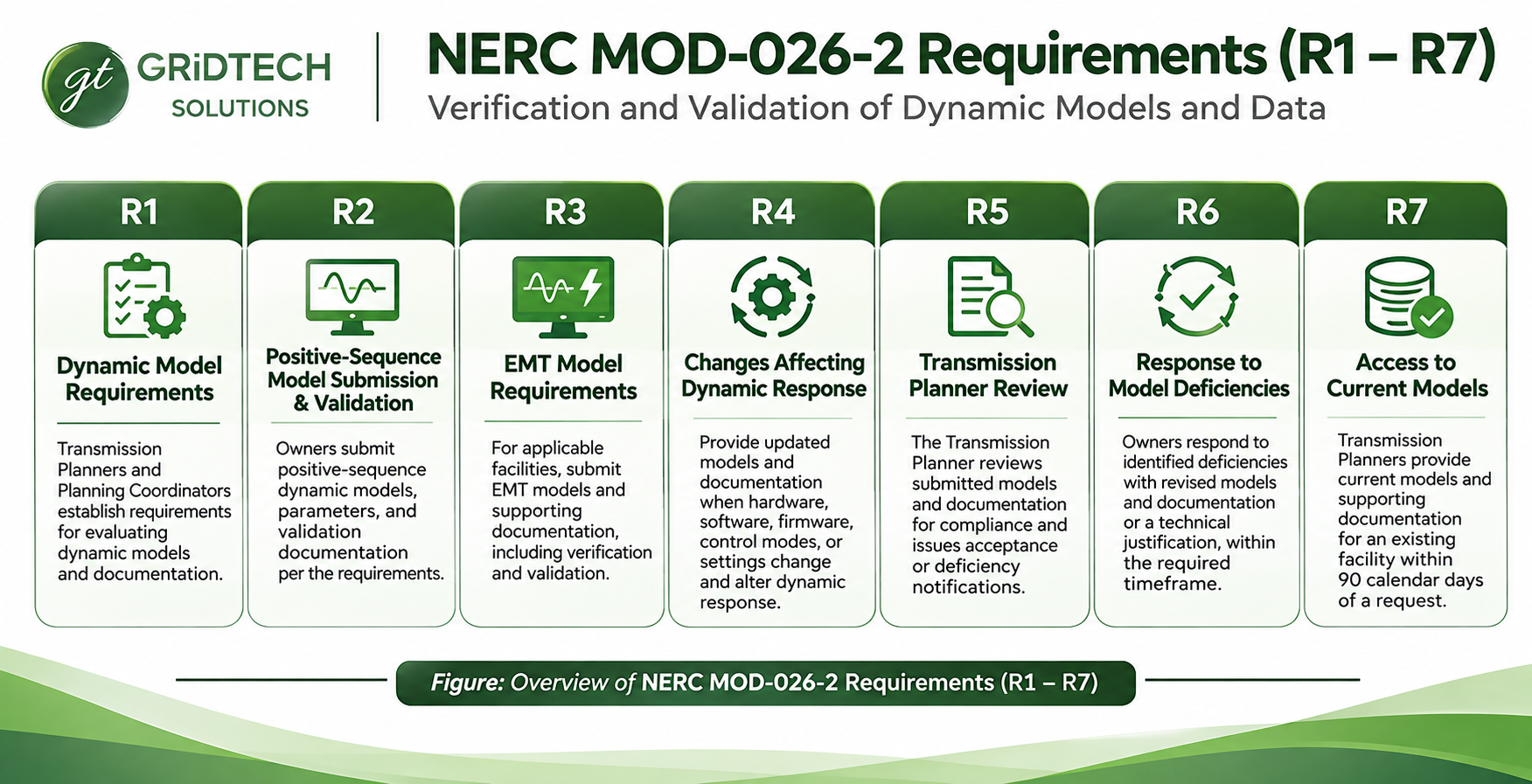
MOD-026-2 establishes seven principal requirements.
R1 — Dynamic Model Requirements
Transmission Planners and Planning Coordinators must jointly develop requirements for evaluating dynamic models and their supporting verification and validation documentation.
These requirements address positive-sequence models, applicable controls and protective functions, and EMT model expectations for specified facilities.
R2 — Positive-Sequence Model Submission and Validation
Applicable Generator Owners and Transmission Owners must provide positive-sequence dynamic models, associated parameters, and supporting documentation according to the standard's periodicity provisions.
Documentation must address model verification and validation, including relevant comparisons with measured voltage/reactive power and active power/frequency responses.
R3 — EMT Model Requirements
For applicable facilities, R3 establishes requirements for electromagnetic transient models and supporting documentation.
The requirements address facility representation, relevant control and protective functions, model verification, and validation against measured responses.
Applicability and exceptions must be evaluated carefully, particularly for legacy facilities.
R4 — Changes Affecting Dynamic Response
When relevant hardware, software, firmware, control modes, or settings change and alter a facility's dynamic response, the applicable owner must provide updated models and supporting documentation.
The standard generally establishes a 180-calendar-day submission period, subject to an agreed alternative timeline.
R5 — Transmission Planner Review
The Transmission Planner evaluates submitted models and documentation against the requirements established under R1.
The standard generally provides 120 calendar days for review, subject to applicable provisions and agreed timelines.
The review results in written acceptance or notification of deficiencies.
R6 — Response to Model Deficiencies
Generator Owners and Transmission Owners must respond when the Transmission Planner identifies unacceptable models or requests additional review.
The response may include revised models and supporting documentation or a technical justification for maintaining the existing models.
The applicable response period depends on the type of notification.
R7 — Access to Current Models
Transmission Planners must provide the current models and supporting documentation for an existing facility within 90 calendar days of a qualifying written request from its owner.
These requirements create an ongoing model management process rather than a single commissioning-related submission.
4. Implementation Timeline and Compliance Planning
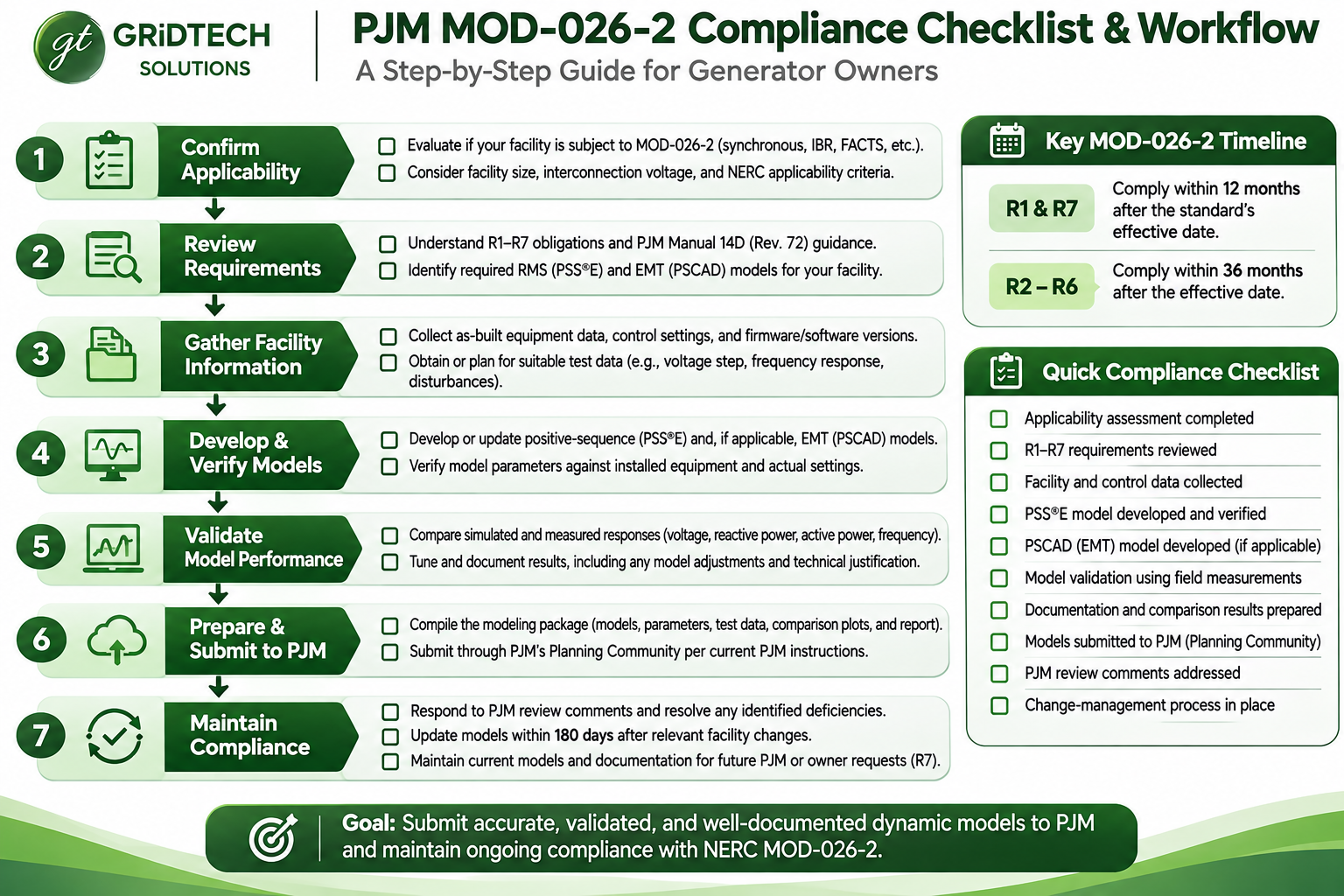
MOD-026-2 includes phased compliance requirements.
Under the final NERC implementation plan:
- R1 and R7 have compliance dates 12 months after the standard's effective date.
- R2 through R6 have compliance dates 36 months after the standard's effective date.
- Additional provisions govern initial performance dates and facilities commissioned before or after the revised standard becomes effective.
The implementation plan also addresses the relationship between prior MOD-026-1/MOD-027-1 submissions and the initial periodic obligations under MOD-026-2.
Generator Owners should establish facility-specific compliance schedules using the approved implementation plan and applicable jurisdictional effective dates.
5. PJM's Generator Modeling and Submission Framework
PJM maintains planning-modeling procedures intended to support reliable system studies and compliance with NERC modeling standards.
PJM's published Planning Modeling Submissions guidance covers MOD-026, MOD-027, and MOD-032 activities, including dynamic modeling data and related submission procedures.
The guidance identifies PJM's Planning Community tool as a mechanism for model submission and review under the historical MOD-026 and MOD-027 processes.
PJM Manual 14D, Generator Operational Requirements, also addresses Generator Owner responsibilities and periodic data submissions.
Revision 72 of Manual 14D became effective November 18, 2026, and includes updates to the guidance associated with Section 7.3.6, Generation Owner Periodic Tasks and Data Submittals.
Generator Owners should use the latest PJM instructions when determining submission formats, required documentation, model versions, and applicable review procedures.
Importantly, older PJM references to MOD-026-1 and MOD-027-1 should not be interpreted as replacing the approved MOD-026-2 requirements.
6. Model Verification Versus Model Validation
Although closely related, model verification and model validation are distinct engineering activities.
Model Verification
Model verification evaluates whether the model structure and configurable parameters accurately represent the installed equipment and its settings.
For example, verification of a solar or BESS facility may include reviewing:
- Inverter manufacturer and equipment ratings
- Inverter control parameters
- Plant-level voltage and reactive power control settings
- Active power and frequency control settings
- Current limits and relevant protective functions
- Transformer and collector system parameters
- Firmware versions and operating modes
The objective is to establish consistency between the simulation model and the actual facility configuration.
Model Validation
Model validation evaluates whether the simulation reproduces the facility's measured response during an appropriate disturbance or staged test.
Examples include:
- Voltage step-response tests
- Reactive power response measurements
- Frequency excursions
- Active power response tests
- Recorded system disturbances
- Other qualifying measurements permitted by the applicable requirements
Validation typically involves applying appropriate measured inputs or operating conditions to the model and comparing simulated and recorded responses.
The engineering assessment should consider response magnitude, timing, damping, settling characteristics, and relevant control behavior.
A model can contain correctly documented parameters yet still fail to reproduce measured dynamic behavior. Both verification and validation are therefore essential.
7. PSS®E Dynamic Model Validation
Positive-sequence transient stability models remain important for PJM transmission planning and reliability assessments.
PSS®E is commonly used to evaluate generator response to voltage, frequency, and network disturbances.
For conventional generating units, model assessments may include generator, excitation, power system stabilizer, turbine-governor, and related control representations.
For inverter-based resources, studies may involve:
- Inverter electrical control models
- Renewable energy or plant-level control models
- Voltage and reactive power regulation
- Active power and frequency response
- Current limiting and control interactions
- Applicable protective and limiting functions
Recommended validation workflow
A practical PSS®E validation process includes:
- Review the existing model and equipment documentation.
- Confirm the facility's operating conditions during the recorded event.
- Verify model parameters against actual control settings.
- Reproduce the relevant test or disturbance conditions.
- Compare simulated and measured active power, reactive power, voltage, and frequency responses.
- Investigate discrepancies and identify their physical causes.
- Update parameters when technically justified.
- Repeat the simulation and document the final results.
Model tuning should preserve realistic equipment behavior rather than merely forcing the simulated response to match one particular test.
8. PSCAD and EMT Modeling Considerations
Electromagnetic transient modeling is increasingly important for evaluating inverter-based resources and other power-electronic facilities.
Unlike positive-sequence RMS models, EMT models can represent faster electrical and control interactions at a more detailed level.
MOD-026-2 R3 establishes EMT model requirements for specified facilities, subject to applicability provisions and exceptions.
A PSCAD model may be used to assess:
- Inverter current-control response
- Voltage and frequency disturbance behavior
- Plant-level controller interactions
- Protective and limiting functions
- Collector system and transformer effects
- Fast control interactions not adequately represented in RMS simulations
The appropriate level of detail depends on the applicable Transmission Planner requirements, facility characteristics, and intended study purpose.
RMS and EMT model consistency
For inverter-based resources, consistency between PSS®E and PSCAD models is an important engineering consideration.
Where appropriate, engineers should compare:
- Active and reactive power response
- Voltage regulation behavior
- Frequency response
- Current limiting behavior
- Control operating modes
- Disturbance recovery characteristics
However, RMS and EMT models have different modeling assumptions and numerical representations. Their results should be compared within the capabilities and limitations of each simulation approach.
9. Common Model Validation Challenges
Incomplete manufacturer information
Original equipment manufacturers may not provide all control parameters or detailed model documentation.
This can complicate verification of installed settings and model functionality.
Differences between design and as-built settings
Commissioning adjustments, firmware updates, and plant controller modifications can cause discrepancies between original model parameters and actual equipment settings.
Insufficient disturbance measurements
Recorded events may not contain enough information to validate every relevant control function.
Measurement quality, sampling rate, signal availability, and operating conditions can all affect validation results.
Weak-grid conditions
At low short-circuit ratios, inverter control interactions can become more sensitive to network impedance and voltage disturbances.
Model validation under these conditions may require additional attention to current limits, plant-level controls, and inverter response.
Multiple interacting control systems
Hybrid solar and BESS facilities may contain multiple inverter types, plant controllers, and operating modes.
These interactions can make it difficult to identify which model parameters are responsible for observed response differences.
Model changes after commissioning
Equipment replacement, software revisions, firmware changes, or modified protection settings may alter dynamic performance.
A documented change-management process helps identify when additional model review or validation is necessary.
10. Recommended Documentation and Deliverables
A technically defensible model validation package should provide sufficient information to demonstrate the relationship between installed equipment, model parameters, and measured performance.
Depending on the facility and applicable requirements, the package may include:
- Facility and equipment descriptions
- Applicable dynamic model files and parameters
- Model version and software information
- As-built control settings and manufacturer documentation
- Test procedures and disturbance records
- Measurement and simulation comparison plots
- Explanation of model adjustments
- Identification of parameters that cannot be verified
- Engineering conclusions and identified limitations
- Supporting evidence and submission records
A clear, traceable documentation package can reduce review delays and facilitate future model updates.
11. How GridTech Solutions Supports PJM Generator Owners
GridTech Solutions provides specialized power system modeling, simulation, and model validation services for conventional and inverter-based generation facilities.
Our engineering support includes:
NERC MOD-026-2 Readiness Assessments
Reviewing existing model documentation, facility characteristics, and available test data to identify technical gaps and potential compliance preparation needs.
PSS®E Dynamic Model Development and Validation
Developing and validating positive-sequence dynamic models for solar, wind, BESS, hybrid, and conventional generation facilities.
PSCAD EMT Model Development and Assessment
Supporting detailed electromagnetic transient modeling, model verification, and disturbance-response evaluations for applicable facilities.
Field Measurement and Simulation Comparison
Comparing recorded equipment behavior with simulated responses and investigating discrepancies in voltage, reactive power, active power, and frequency performance.
Model Parameter Verification
Reviewing model settings against manufacturer information, commissioning records, and actual plant control configurations.
Model Quality Testing and Technical Documentation
Preparing model quality assessments, simulation results, comparison plots, and technical reports to support Generator Owner submissions and engineering reviews.
PJM Model Submission Support
Assisting Generator Owners with technical documentation, model corrections, and responses to PJM modeling review comments.
Our approach emphasizes accurate physical representation, technically justified model adjustments, and documentation that supports long-term model maintenance.
12. Frequently Asked Questions
1. What is NERC MOD-026-2, and why is it important for generator owners?
NERC MOD-026-2, Verification and Validation of Dynamic Models and Data, establishes requirements to demonstrate that dynamic simulation models and their associated parameters accurately represent equipment operating in the field.
The standard supports reliable Bulk Electric System planning by requiring applicable entities to verify site-specific model parameters and validate simulated responses against measured equipment behavior.
For generator owners in PJM, this means reviewing both model performance and the accuracy of the underlying equipment settings, controls, and parameters. A model that produces a reasonable simulation response may still require additional documentation to demonstrate that its parameters reflect the installed equipment.
2. Which generating facilities are subject to MOD-026-2?
MOD-026-2 applies to specified facilities and registered entities, including applicable Generator Owners, Transmission Owners, Transmission Planners, and Planning Coordinators.
Covered facility types include:
- Synchronous generating units and facilities meeting the applicable Bulk Electric System definition criteria.
- Bulk Electric System inverter-based resources, including applicable solar, wind, and battery energy storage facilities.
- Certain non-BES inverter-based resources with an aggregate nameplate capacity of at least 20 MVA and a qualifying connection at 60 kV or higher.
- Applicable synchronous condensers, FACTS devices, and HVDC systems.
Applicability depends on the facility configuration, NERC definitions, and the criteria specified in Section 4 of MOD-026-2. Generator owners should perform a facility-specific applicability assessment rather than assuming that all generating facilities have identical obligations.
3. What are the seven requirements under MOD-026-2?
MOD-026-2 contains seven requirements addressing model specifications, submissions, verification, validation, review, and maintenance.
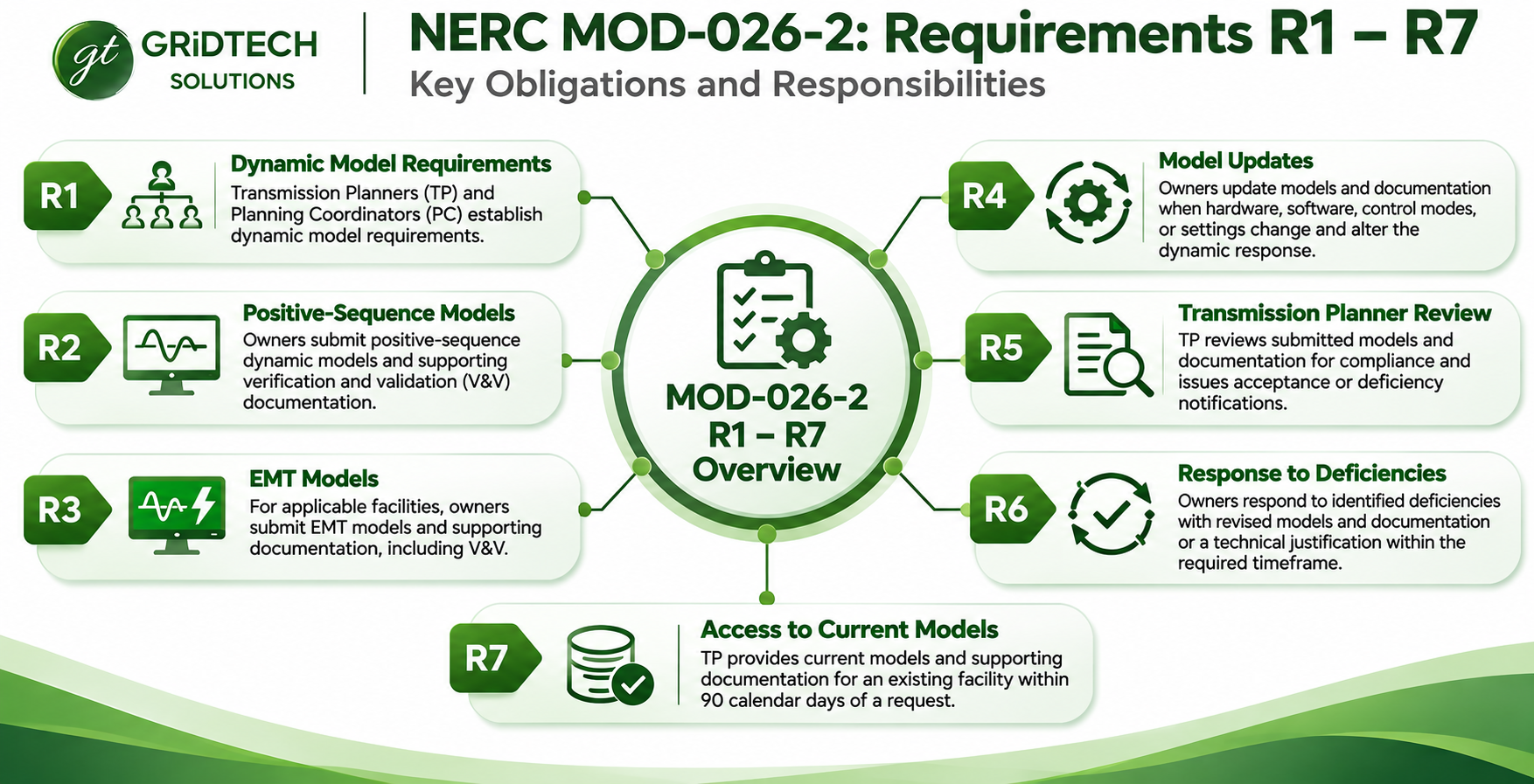
The requirements have different responsibilities and compliance timelines. Generator owners should review the official standard and implementation plan to determine which obligations apply to their facilities.
4. How does MOD-026-2 differ from MOD-026-1 and MOD-027-1?
MOD-026-2 consolidates the earlier generator excitation and governor model verification standards into a unified framework.
The previous standards addressed generator excitation, voltage/reactive power controls, governor systems, and active power/frequency controls.
MOD-026-2 expands the framework by:
- Requiring more explicit verification of configurable, site-specific model parameters.
- Establishing EMT modeling and validation requirements for applicable inverter-based resources and other specified facilities.
- Addressing limiting and protective functions.
- Establishing processes for model review, deficiencies, and updates following relevant equipment or control changes.
- Expanding applicability to certain non-BES inverter-based resources.
MOD-026-2 became effective on April 1, 2026. Under the approved implementation plan, R1 and R7 have a phased compliance date of April 1, 2027, while R2–R6 have a phased compliance date of April 1, 2029, subject to applicable facility-specific provisions.
5. What field measurements and operating data are needed for MOD-026-2 model validation?
MOD-026-2 requires documentation comparing simulated dynamic behavior against measured behavior from staged tests or system disturbances, as applicable.
Relevant measurements may include:
- Terminal or point-of-interconnection voltage.
- Active and reactive power.
- System frequency.
- Generator or plant controller response.
- Excitation and voltage-control response.
- Governor and active-power control response.
- Relevant operating conditions and equipment settings.
For qualifying frequency-disturbance validation in the Eastern Interconnection, including PJM, the standard specifies a frequency deviation of at least 0.04 Hz from scheduled frequency while the facility operates in a frequency-responsive mode.
The specific data and tests needed depend on the applicable models, control functions, and requirements. For EMT model validation, additional evidence and large-signal comparisons may be necessary.
6. How are PSS®E and PSCAD models used for MOD-026-2 compliance in PJM?
PSS®E and PSCAD support different aspects of dynamic model assessment.
PSS®E is commonly used for positive-sequence dynamic simulation. Engineers can use it to evaluate generator, excitation, voltage-control, governor, and active-power control responses and compare simulated results with field measurements.
PSCAD supports electromagnetic transient simulation, providing detailed representations of inverter controls, electrical equipment, protection, and fast dynamic interactions.
For applicable inverter-based resources, MOD-026-2 may require EMT models, documentation demonstrating model verification and validation, and comparisons between positive-sequence and EMT responses for specified large-signal disturbances.
Neither software platform automatically establishes compliance. The models, supporting evidence, and documentation must satisfy the applicable NERC requirements and Transmission Planner specifications.
7. What documentation must generator owners submit to PJM for MOD-026-2?
Applicable generator owners should prepare a documented model-validation package appropriate to their facility and applicable requirements.
The package may include:
- Positive-sequence dynamic models and associated parameters.
- Applicable EMT models and supporting documentation.
- Equipment specifications, control settings, and parameter-verification records.
- Field-test or disturbance measurements.
- Simulation-to-measurement comparisons.
- Explanations for parameters that cannot be verified.
- Supporting technical reports and model-revision records.
- Documentation addressing applicable Transmission Planner requirements.
PJM's publicly available Planning Modeling Submissions guidance describes using its Planning Community tool for MOD-026 and MOD-027 model submissions under the earlier standards.
Generator owners should confirm PJM's current MOD-026-2 submission instructions, accepted model formats, and documentation requirements before submitting their packages.
8. How can GridTech Solutions support PJM generator owners with MOD-026-2 compliance?
GridTech Solutions provides engineering support for generator model development, verification, validation, and compliance assessments.
Our services include:
- MOD-026-2 applicability and readiness assessments.
- Review of generator, inverter, and plant controller models.
- PSS®E positive-sequence dynamic model development and validation.
- PSCAD EMT model development and performance evaluation.
- Field measurement and disturbance-data analysis.
- Comparison of simulated and measured voltage, reactive power, active power, and frequency responses.
- Review of model parameters against installed equipment and control settings.
- Preparation of technical reports and supporting compliance documentation.
- Engineering support for PJM model-submission reviews and responses to identified deficiencies.
Conclusion
NERC MOD-026-2 represents an important evolution in dynamic model verification and validation requirements.
By consolidating the previous excitation-system and governor-model standards, expanding applicability, and establishing more comprehensive RMS and EMT modeling provisions, the revised standard strengthens the connection between simulation models and actual facility performance.
For PJM Generator Owners, successful preparation requires more than submitting model files. It involves understanding equipment behavior, verifying control settings, evaluating measured disturbances, documenting model accuracy, and maintaining models as facility configurations change.
GridTech Solutions supports these activities through PSS®E and PSCAD modeling, dynamic simulation, model validation, and technical compliance support.
Need assistance with MOD-026-2 model validation?
GridTech Solutions supports generator owners, renewable energy developers, and power plant operators with dynamic modeling, technical assessments, and compliance documentation.
Contact us at info@gridtechsolution.com to discuss your project.
Official References
- NERC MOD-026-2 — Verification and Validation of Dynamic Models and Data
- NERC MOD-026-2 Implementation Plan — October 2025
- PJM Planning Modeling Submissions
- PJM Manual Updates — Manual 14D, Revision 72
Technical note: This article provides an engineering overview based on the referenced standards and publicly available guidance as of November 2026. Facility-specific compliance obligations should be confirmed against the applicable effective dates, NERC requirements, and current PJM procedures.